
|
30 July 2026 How AI Is Changing the Hidden World of Retail Orders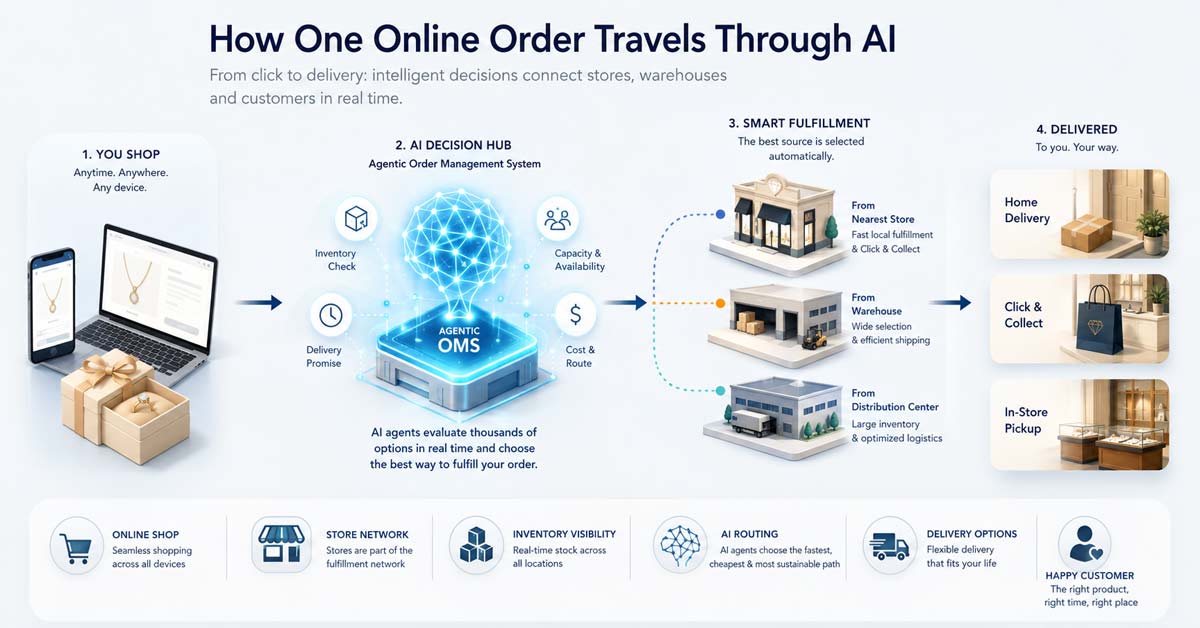
Quick Read
Retail has changed dramatically over the past decade. Customers now move effortlessly between physical stores, websites, mobile apps and social media before making a purchase. This seamless interaction between sales channels—known as omnichannel retail—has become the new standard. Behind the scenes, however, it requires an increasingly sophisticated digital infrastructure that coordinates products, inventory and deliveries across many locations simultaneously.
• Shopping no longer ends at the checkout or the "Buy now" button. Modern retail increasingly relies on intelligent software that decides where products should come from and how they reach customers fastest. From shelves and warehouses to intelligent networksOnly a few years ago, many retailers still operated with large, integrated software systems that handled almost every business process. These so-called monolithic systems stored product data, managed inventories, processed orders and often even powered online shops. While reliable, they were also difficult to adapt. Adding new services or integrating innovative technologies often meant changing the entire system.As online shopping expanded rapidly during the 2010s, retailers needed greater flexibility. This led to a gradual shift towards modular software architectures. Instead of relying on one giant application, companies began combining specialised solutions that communicate through digital interfaces. Today this approach is widely known as Composable Commerce. The concept resembles assembling a professional toolkit rather than buying a single multi-purpose device. Each software component focuses on one specific task—whether it is online checkout, product information, customer communication or order management. Because the modules can be exchanged independently, retailers can modernise individual parts without replacing their complete IT landscape. Artificial intelligence moves into retail operationsThe latest stage of this development goes beyond modular software. Increasingly, artificial intelligence is taking over operational decisions that previously depended on predefined rules or manual intervention. This new generation of systems is often described as Agentic AI. Unlike conventional software that simply follows programmed instructions, agentic systems pursue defined goals. They continuously evaluate changing conditions, compare alternatives and recommend—or even execute—the most suitable action.In retail, these capabilities are becoming particularly important in Order Management Systems (OMS). Traditionally, an OMS records customer orders and coordinates fulfilment. Modern AI-enhanced systems add another layer of intelligence by analysing inventory levels, delivery times, shipping costs and store capacities simultaneously. Instead of following fixed "if-then" rules, the software continuously calculates the most efficient way to fulfil each individual order. If one location runs low on stock, another store may automatically take over. If unexpected disruptions occur, the system can adjust routing without waiting for manual intervention. The result is not simply faster deliveries. Retailers gain greater flexibility, better inventory visibility and a more resilient supply chain, while customers receive more reliable availability information across online shops and physical stores alike. Behind every online order lies a growing number of digital decisionsMany shoppers assume that clicking "Buy" simply sends an order to a warehouse. In reality, modern retail operations have become far more dynamic. One order may pass through several software layers before an employee even picks up the product. The system first checks stock across warehouses and stores, estimates delivery promises, compares transport options and evaluates where fulfilment can be completed most efficiently. These decisions increasingly happen within seconds—and often without direct human involvement.For employees, this changes everyday work as well. Store staff are becoming part of a connected fulfilment network rather than serving only walk-in customers. A local shop may simultaneously advise customers on the sales floor, prepare online orders for collection and dispatch products to customers elsewhere. The store itself becomes an active logistics hub within a digitally coordinated retail ecosystem. CHRIST's technology upgrade reflects a wider retail transformationAgainst this backdrop, the latest technology project at CHRIST Juweliere und Uhrmacher illustrates how established retailers are adapting to a changing digital landscape. Founded in 1863, CHRIST today employs more than 2,000 people and operates more than 200 stores across Germany and Austria. Only recently, the company reopened its modernised flagship store on Vienna's Mariahilfer Straße, underlining that physical retail remains an important part of its strategy alongside digital channels.At the end of July 2026, CHRIST announced that it is modernising its commerce architecture with three specialised technology partners. The retailer is implementing fulfillmenttools' Agentic Order Management System, commercetools' composable commerce platform, while retail transformation specialist KPS supports the implementation and architectural redesign. Rather than replacing every existing system at once, CHRIST is gradually separating individual functions into specialised software modules. This step-by-step migration reduces disruption while allowing the company to introduce new capabilities where they provide the greatest benefit. What the new system actually doesThe most visible change for customers may simply be that products appear available more often and delivery information becomes more reliable. Behind the scenes, however, the software performs a much broader task. The new Order Management System becomes the central decision layer connecting stores, warehouses and online shops across countries. Every incoming order is analysed in real time before the system determines where it should be fulfilled. Instead of automatically assigning an order to a central warehouse, the software evaluates several factors simultaneously. It considers inventory levels, delivery times, transport costs, store capacity and shipping options before selecting the most suitable fulfilment location.This approach is increasingly known as Agentic Order Management. Rather than following rigid decision trees, embedded AI agents continuously evaluate changing conditions and adjust recommendations as circumstances evolve. If stock becomes unavailable, transport routes change or unexpected disruptions occur, the system can immediately calculate an alternative solution. For retailers, this improves operational flexibility. For customers, it mainly means more accurate availability information, faster fulfilment and a more consistent shopping experience whether purchasing online or visiting a store. From REWE Digital to an independent retail technology companyThe technology provider behind the new Order Management System also reflects a wider trend in retail innovation. fulfillmenttools originated as a high-tech spin-off from REWE Digital, the digital technology division of the REWE Group, whose retail businesses include supermarket chains such as BILLA, BIPA, PENNY and REWE. Today, fulfillmenttools operates as a specialised software company while remaining backed by the REWE Group's retail ecosystem.This background illustrates how retailers increasingly develop technologies not only for internal use but also as software products for the wider market. Experience gained from managing complex retail operations can become the foundation for digital platforms that other international retailers adopt. The move also highlights another shift within the retail sector. Competitive advantage no longer depends solely on store design, product ranges or pricing. Increasingly, it also depends on invisible software that coordinates inventory, predicts demand and makes thousands of operational decisions every day. Artificial intelligence therefore becomes less visible to shoppers than popular consumer AI applications. Instead of generating text or images, it quietly manages logistics, inventory and fulfilment in the background. As retailers continue investing in modular commerce architectures and AI-assisted decision systems, many of the innovations shaping tomorrow's shopping experience will remain hidden from customers. Yet they increasingly determine whether products are available, how quickly they arrive and how smoothly physical stores and online channels operate together. For consumers, the purchase may still appear simple. Behind the scenes, however, retail has become one of the most sophisticated applications of artificial intelligence in everyday business. Image: AI-generated illustration showing a modern omnichannel retail operation where physical stores, warehouses and online orders are connected through intelligent order management software. © Fashion.at, AI-generated with ChatGPT. |