
21 May 2026 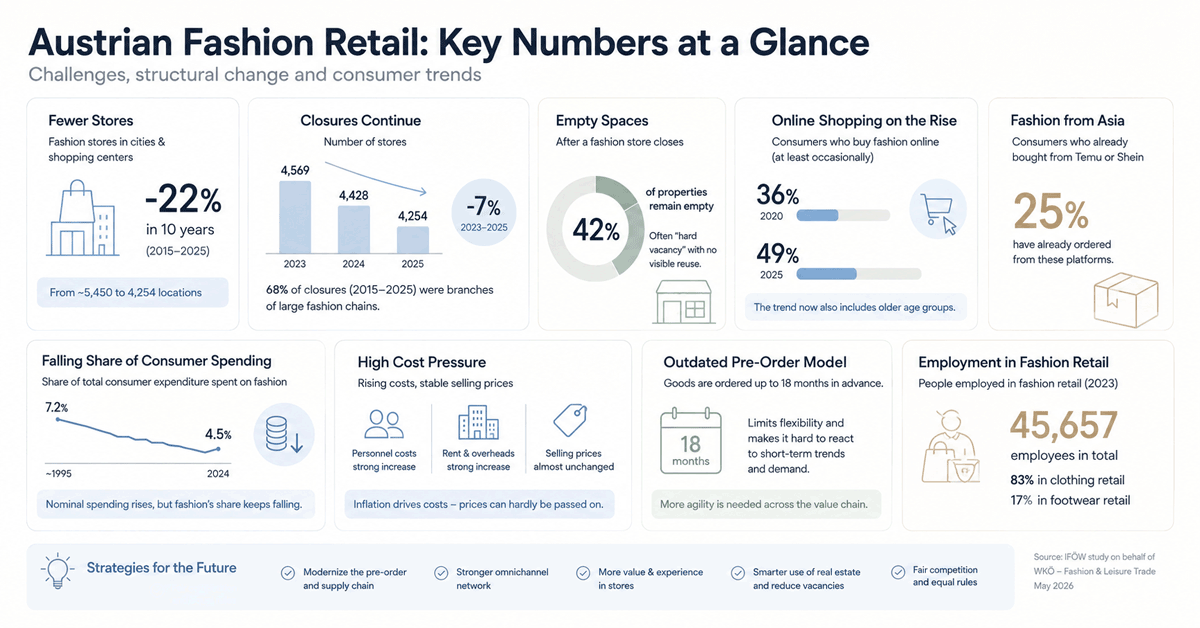
Quick Read
• New figures presented on 21 May by the Austrian Federal Economic Chamber (WKÖ) and the Institute for Austrian Economic Research (iföw) show mounting pressure on Austria's fashion retail sector.
Retail Under Pressure as Costs RiseThe Austrian fashion retail sector is entering another phase of structural transformation. New industry data presented on Thursday in Vienna by the Austrian Federal Economic Chamber (WKÖ) and the Institute for Austrian Economic Research (iföw) outlined a market increasingly shaped by inflation, digital competition and changing consumer habits. According to the study presented by economic researcher Peter Voithofer and WKÖ sector chairman Günther Rossmanith, around 45,657 people worked in Austria's fashion retail sector in 2023. About 83% were employed in clothing retail and 17% in shoe retail.While Austrians still spend money on clothing and shoes, fashion now represents a smaller share of overall household consumption than in previous decades. Around 30 years ago, fashion accounted for 7.2% of consumer spending; in 2024 the share had declined to 4.5%. The study links this development partly to inflation and partly to broader lifestyle changes accelerated during and after the pandemic years. Home office culture and more relaxed dress codes have reduced the everyday need for formal or seasonal wardrobe updates. Similar findings had already appeared in the Gallup study "Modehandel: Einkaufsverhalten und Zukunftsperspektiven", presented in January 2025. Online Shopping Reaches Older GenerationsThe latest data also shows how online fashion shopping has moved further into mainstream behaviour across age groups. In 2020, 36% of Austrian consumers said they occasionally bought fashion online. By 2025, the figure had risen to 49%. The shift is no longer limited to younger consumers. The study highlights that older age groups are now increasingly adopting online shopping habits as digital retail becomes routine in daily life.At the same time, Austrian retailers continue to criticize the competitive advantages of large international low-cost platforms such as Temu and Shein. According to the presentation, one in four people in Austria has already purchased fashion products from these platforms. Retail representatives argue that tax structures, customs regulations and differing product standards create unequal conditions between European retailers and global online sellers. The Pre-Order System Becomes a Structural ProblemOne of the central issues raised during the presentation concerned the traditional "pre-order" model still widely used in the fashion industry. Retailers often commit to collections up to one and a half years in advance. In a market increasingly driven by rapid online trends, viral products and unpredictable demand shifts, this system limits flexibility. If consumer preferences suddenly change, physical retailers may already be locked into large orders planned long before products reach stores. The study suggests this reduces the ability of traditional fashion retail to react quickly compared with digital-first competitors operating on shorter production cycles.Industry representatives therefore called for more flexible supply structures, faster delivery systems and improved coordination between manufacturers and retailers. Other proposed strategies included: • stronger online integration alongside physical stores • clearer brand positioning • experiential retail concepts • service-oriented shopping environments • more realistic commercial rent expectations • stricter enforcement of European safety and customs standards for international platforms Store Closures Leave Visible Gaps in CitiesThe effects are increasingly visible in Austrian cities and shopping centres. Within ten years, the number of fashion stores in Austria declined by 22% to 4,254 locations. Shoe retail was particularly affected, shrinking by 34%. The study also examined the impact on the real estate sector. Around 42% of retail locations vacated by fashion businesses currently remain empty without visible new use. The figures indicate that retail transformation is no longer only a retail issue but increasingly an urban development and property market issue as well. Retail representatives criticized rent expectations that continue to rise despite shrinking retail turnover and changing foot traffic patterns in many city centres.Comment: Fashion Consumption Is Changing Beyond RetailBeyond the issues discussed during the WKÖ presentation, another long-term development increasingly shapes the fashion market: the rise of second-hand fashion. Over roughly the last decade, Austria's second-hand sector has evolved from a niche market into a mainstream part of fashion consumption. Digital platforms such as Willhaben and Vinted helped normalize the resale of clothing, shoes and accessories across broader age groups.At the same time, specialized vintage and curated resale boutiques expanded particularly in Vienna and other urban centres. Fashion resale is no longer associated only with low-cost consumption; for many consumers it has become linked to sustainability, individuality and circular economy concepts. This trend was not yet strongly emphasized in the WKÖ/Gallup fashion retail study presented in January 2025, which focused more heavily on inflation, home office culture and changing dress codes. Yet the second-hand market increasingly represents a structural factor in fashion retail itself. A parallel can be observed in electronics, where "refurbished" products have become widely accepted. In fashion, a comparable concept of professionally resold or "pre-used" products could become part of a broader adaptation strategy for traditional retailers responding to contemporary consumer behaviour. Rather than existing outside the retail system, resale may increasingly become integrated into it. Image: Infographic visualizing key figures from Austria’s fashion retail sector in 2026, including store closures, online shopping growth, retail vacancies and changing consumer trends. © Fashion.at |