
|
6 November 2026 Winter Sports Spending: Clothing Leads, Specialist Shops Win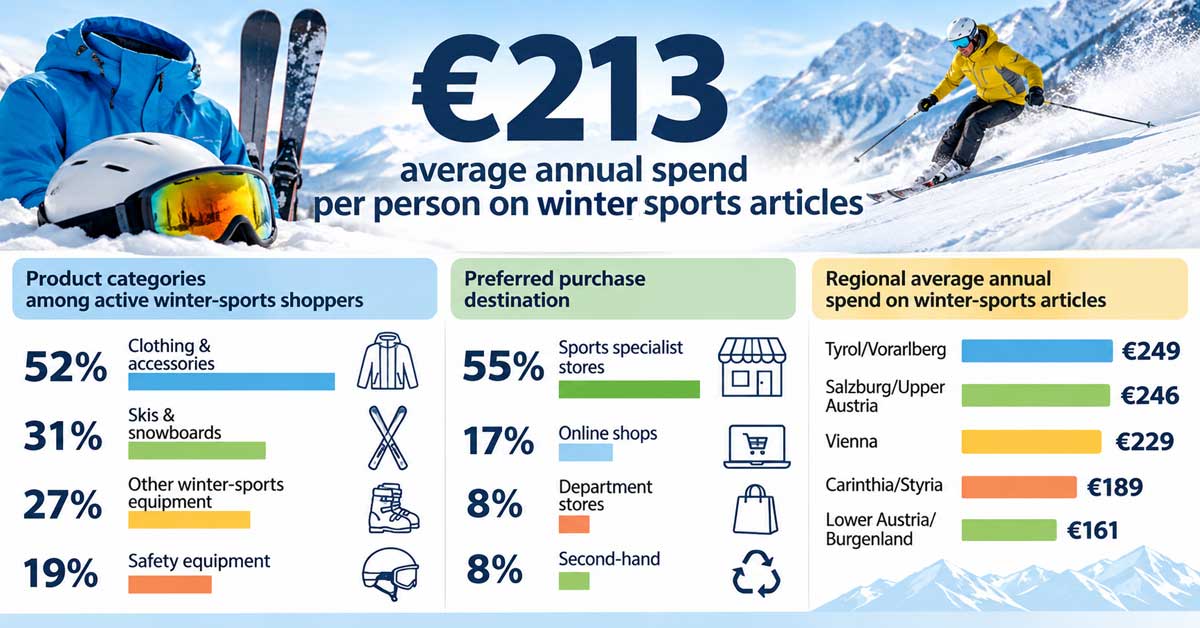
Quick Read
The figures come from the latest HV Consumer Check, a regular survey commissioned by the Handelsverband (Austrian Retail Association). Founded in 1921, the independent, non-partisan association represents Austrian retail companies and acts as an industry platform. For this survey, market research institute Reppublika Research & Analytics interviewed 1,013 people aged 18 and over between 2 and 17 October 2026. The online survey used Computer Assisted Web Interviews (CAWI) and is described as representative of Austria's adult population.
• Austrians spend an average of €213 per person annually on winter sports articles.
Clothing and accessories lead winter sports purchasesClothing and accessories are the most frequently mentioned category among winter sports products already purchased or planned for the 2026/27 season. They account for 52% of responses. Skis and snowboards follow at 31%, while other equipment, including sledges and ice skates, reaches 27%. Safety products such as helmets, protectors and ski goggles account for 19%.Overall, 20% of active winter sports participants have already bought equipment for the coming season, while another 19% intend to do so. Together, this represents a purchase activity rate of 39%. The regional spending figures reveal a clear difference between Austria's regions. Tirol and Vorarlberg lead with an average annual budget of €249 per person for winter sports articles. Salzburg and Upper Austria follow closely at €246. These western and central regions are home to numerous established ski resorts and have a particularly close connection to winter sports. Vienna ranks third, with €229 per person. Although the capital does not have the same immediate access to Alpine ski areas, winter holidays and trips to the mountains have long been part of the city's relationship with winter sports. Kärnten and Styria follow with €189. Both southern provinces also have established winter sports destinations. At the other end of the ranking, Lower Austria and Burgenland record €161. Half of Austrians are considering winter sportsThe survey also asked about plans for the 2026/27 winter season. Forty per cent of respondents say they definitely intend to take part in winter sports, while another 16% are considering it.The regional differences are reflected in these plans. In Tirol and Vorarlberg, 50% intend to participate, compared with 43% in Salzburg and Upper Austria. Kärnten and Styria, as well as Lower Austria and Burgenland, each reach around 38%. Vienna records 32%. Age is another important factor. Winter sports plans are particularly common among younger adults: 61% of Generation Z (18–29) and 55% of Millennials (30–44) say they definitely plan to take part. The share falls to 33% among Generation X (45–61) and 21% among respondents over 61. Specialist sports retailers remain the first choiceWhen it comes to buying winter sports equipment, specialist sports retailers are clearly the preferred destination. Fifty-five per cent of active winter sports participants name the sports trade as their first choice. Online shops rank second at 17%. Department stores and second-hand offers each account for around 8%.There are practical reasons why specialist shops remain important in this category. Winter sports equipment can be technically demanding and requires more than simply comparing prices or specifications online. Advice on the latest technologies, correct fit, sizing and individual requirements can make a significant difference. This is particularly relevant for ski boots, helmets and other safety-related products. Personal guidance can also help customers understand how equipment works and what to look for when using it. Younger buyers are more active, Generation X spends moreThe generational figures reveal an interesting contrast between purchase activity and spending levels.Among active winter sports participants in Generation Z (18-29 years of age), 32% have already bought equipment and another 23% plan to do so. Together, 55% are either already buying or preparing to purchase. This is the highest purchase activity among the generations surveyed. However, the average annual spending is highest among Generation X (45-61 years), at €252. Respondents over 61 spend an average of €221, followed by Millennials (30-44 years) at €203. Generation Z records the lowest average, at €169. In other words, younger people are more likely to be involved in current purchasing decisions, but their average budgets are smaller. Generation X combines a lower level of purchasing activity with the highest expenditure per person. Renting remains an alternative to buyingOwning winter sports equipment is still the most common arrangement, but it is not the only one. Seventy-one per cent of respondents who ski, snowboard, cross-country ski or go ski touring use their own equipment exclusively. Thirteen per cent rely entirely on rented equipment, while 16% combine their own gear with rentals.That means 29% use rented equipment at least some of the time. Renting can make practical sense for occasional winter sports participants, families with growing children or people who want to try a new activity before investing in their own equipment. The figures suggest that buying is not always the first step towards taking part in winter sports. Particularly when equipment is expensive, highly specialised or needed only occasionally, renting offers a way to get started without committing to a full set of gear. |