
|
7 November 2026 BLICKFANG Vienna 2026: New Materials and Ideas in Design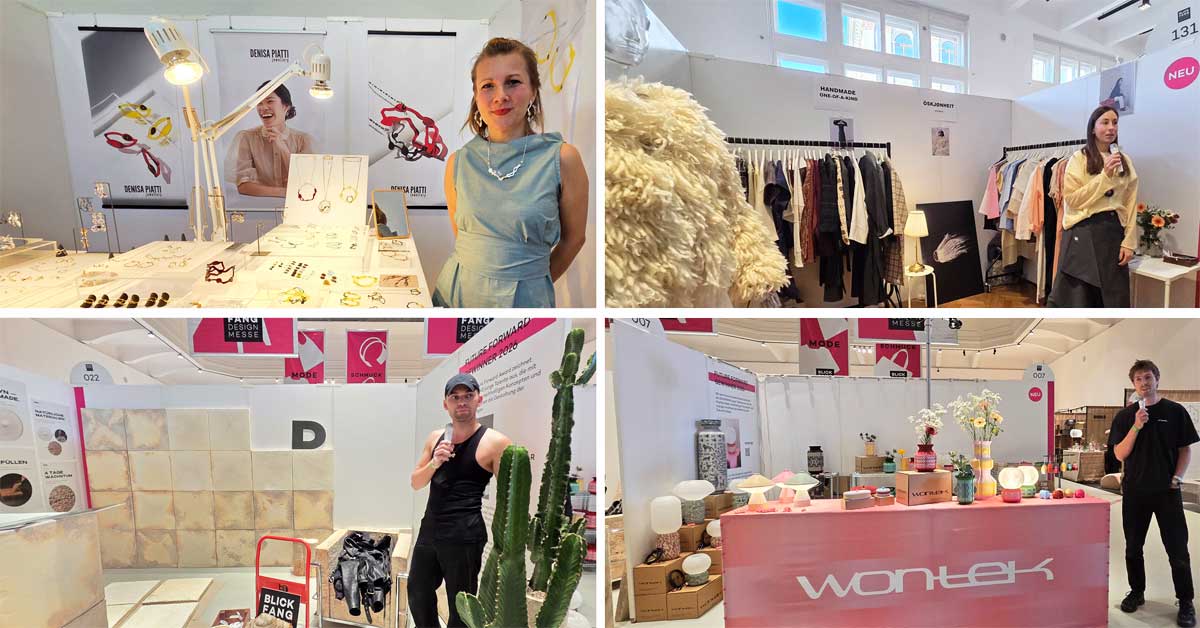
Quick Read
The BLICKFANG design fair opened at the Museum of Applied Arts (MAK) in Vienna on 6 November, bringing together around 160 independent labels from more than 15 countries. During the official press tour, Fashion.at visited selected stands an hour before the doors opened to the public. The designers introduced their work, explained their choice of materials and demonstrated some of the techniques behind their products. Several encounters illustrated how contemporary design is moving beyond familiar distinctions between fashion, craft, technology and furniture.
• The BLICKFANG press tour at Vienna's MAK on 6 November offered an early look at independent design, from experimental jewellery and upcycled fashion to furniture that encourages movement.
Jewellery and fashion: Giving materials a second lifeSlovak-born jewellery artist Denisa Piatti brought an unusual combination of materials to the press tour. Her work challenges conventional ideas about what makes jewellery precious. Instead of relying exclusively on gold, silver and gemstones, she combines traditional jewellery techniques with materials such as brightly coloured acrylic. Her Seaweed collection is a good example. Inspired by seaweed washed ashore and dried by the sun, the pieces translate organic shapes into jewellery. The acrylic elements are hand-cut and laser-cut before being combined with oxidised or brushed sterling silver. The result is a contrast between the almost fluid appearance of the forms and the technical precision of their production. Piatti studied traditional goldsmithing in Slovakia and later developed her design practice internationally, including in the United States. She now lives and works in Vienna. Since 2026, she has also been part of the team at the jewellery studio STOSSIMHIMMEL in Vienna's first district.Another perspective on the relationship between material and fashion came from ÖSKJONHEIT, the Vienna-based label founded by designer Lada Žikić. The label works with upcycled textiles and deadstock materials, turning existing fabrics into contemporary clothing. Its approach is not simply about reusing old clothes. It also involves looking at the cultural stories carried by garments and textile techniques. The collection P.O.P.P. (Power of Past & Present), for example, takes inspiration from historical figures such as Austrian women's rights activist Adelheid Popp and reinterprets historical clothing through contemporary design. The use of previously existing materials connects the collection with a broader discussion about fashion production: how can textiles and their histories be given another life rather than being treated as disposable resources? Active sitting: Furniture that encourages movementFashion.at already encountered MOWO – Move with Wood during Vienna Design Week in 2023. At this year's BLICKFANG, designer Lisa Stolz presented her furniture concept, which questions one of the most familiar everyday activities: sitting. Stolz is an architect and furniture designer from Vienna. She studied architecture at the Vienna University of Technology and furniture design at Central Saint Martins in London. MOWO emerged from her interest in creating flexible wooden furniture that responds to the movements of the body. The furniture is made from elastic moulded plywood. Rather than providing a rigid seat, the construction responds to the movements of the person sitting on it. Trying one of the stools feels a little like sitting on a fitness ball, although the effect depends on the particular model. Some stools allow forward and backward rocking, others move sideways, while another design encourages alternating movements of the hips. The different constructions therefore create different kinds of movement and balance challenges. The idea is to make sitting less static. The body continuously adjusts to the flexible surface, turning an otherwise passive activity into a more dynamic experience.Future Forward: Growing materials and rethinking productionTwo very different approaches to material innovation are represented by this year's BLICKFANG Future Forward award winners, RUND Biomodular Design from Berlin and WONTEK from Warsaw.RUND Biomodular Design was founded by Max and Andy, who began developing their products in 2023. The studio works with mycelium, the network of fine fungal threads that forms the vegetative structure of fungi. Combined with hemp residues and grown in moulds, the material develops into solid forms that can be used for furniture and interior applications. The process is different from conventional furniture production. Instead of cutting, shaping or assembling a finished industrial material, the designers use biological growth as part of the manufacturing process. At the press tour, RUND showed acoustic panels for interior spaces as well as seating. The material is particularly interesting to touch: its surface has a soft, almost velvety quality, quite different from the appearance one might expect from a material grown with fungi. The concept also raises questions about the life cycle of furniture. Mycelium composites can be designed to biodegrade after use, but their actual durability and disposal conditions depend on the material formulation and construction. WONTEK, the second Future Forward winner, takes a different route. The Warsaw-based label was founded by Polish product designer Stanisław Stupkiewicz, who studied at the Faculty of Design of the Academy of Fine Arts in Warsaw. His work combines traditional textile references with digital manufacturing. The central idea is to understand 3D printing as a contemporary form of weaving. Instead of hiding the characteristic lines and layers created during printing, WONTEK makes them part of the design. The resulting objects can look as if they were made from woven textiles or covered with intricately patterned ceramic surfaces. The collection includes vases, lighting and decorative objects. Its visual language draws on the colours, textures and ornamentation of traditional Polish textiles, including patterns inspired by handwoven fabrics from eastern Poland. WONTEK translates these textile references into digital structures, allowing a machine-based process to produce surfaces with a distinctly handcrafted appearance. The result is an interesting meeting of traditional pattern-making and contemporary production technology. Design Prize: Three categories, different approachesAt the time of the press tour, the winners of the main BLICKFANG Design Prize, selected by this year's jury, had not yet been discussed during the stand visits. The jury brings together expertise from fashion design and entrepreneurship, design management, interior architecture and sustainable building, as well as design journalism. The award recognises outstanding work in three categories: furniture, fashion and accessories. The BLICKFANG stand talks with the winners were scheduled for Saturday, 7 November, with separate sessions for each category.A few hours after the press tour, however, the results were already public. In an Instagram announcement, BLICKFANG named the following winners: - Furniture – inox système: Bratislava-based designer Jakub Kolarovič explores the possibilities of stainless steel through handmade objects and carefully finished surfaces. - Fashion – LEA LAHR: Lea Theres Lahr-Thiele uses her Counterform method to turn deadstock textiles into gender-fluid, one-of-a-kind couture pieces. - Accessories – ATIE: Founded by three friends, the label gives the traditional silk scarf a contemporary interpretation. The scarves are designed in Austria and produced in Italy. The three awards illustrate different ways of approaching design: through material experimentation, resource-conscious fashion production and the reinterpretation of an established accessory. The BLICKFANG once again brings together a broad range of creative approaches. What connects many of the selected works is an interest in how materials can be transformed, reused or developed in new ways. Questions of circularity, craftsmanship, technological innovation and the relationship between an object and its user are present throughout the fair. Until Sunday, 8 November, the MAK offers an opportunity to see these ideas not only in photographs or descriptions, but in the objects themselves – and to speak directly with the people who designed them. |