
|
22 July 2026 EU Ban on Destroying Unsold Clothing: Austria Prepares for a New Textile Economy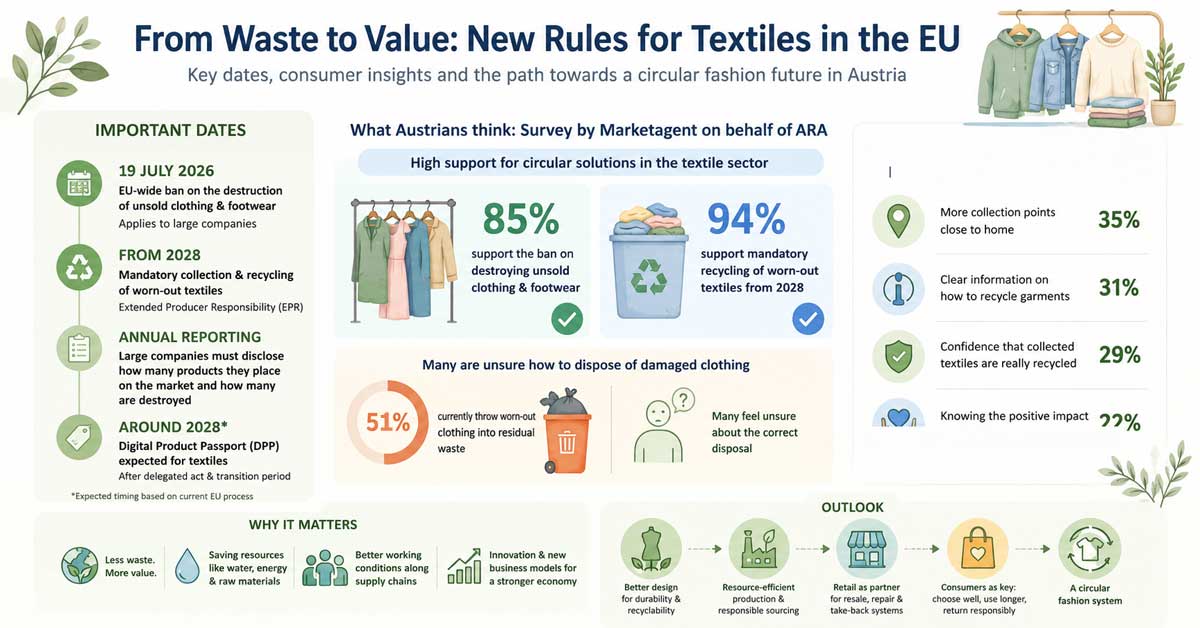
Quick Read
The destruction of brand-new clothing has long symbolised one of the fashion industry's most visible contradictions: products manufactured with significant amounts of energy, water and raw materials were sometimes discarded without ever reaching consumers. Since 19 July 2026, this practice has become largely prohibited for large companies across the European Union under the Ecodesign for Sustainable Products Regulation (ESPR).
• Since 19 July 2026, large companies across the EU may no longer destroy unsold clothing and footwear under the Ecodesign for Sustainable Products Regulation (ESPR). The new rules currently apply to large enterprises, defined under EU criteria as companies with more than 250 employees or annual turnover above the relevant thresholds. In Austria, this means only a few dozen companies are directly affected today, although many international fashion groups operating on the Austrian market must also comply through their European organisations. Medium-sized companies are expected to be covered after a transition period, while small businesses remain exempt. Different Views on the New RulesThe regulation has received broad support in Austria, although organisations differ in their assessment of whether it goes far enough.Südwind, an Austrian non-governmental organisation focusing on global justice, human rights and sustainable development, welcomes the ban as an important milestone against waste in the fashion industry. At the same time, the organisation argues that the regulation still contains significant loopholes. It warns that donations should not become a way to shift disposal problems to countries in the Global South and points out that recycling is often complicated because many garments contain mixed fibres that remain difficult to separate. Südwind also stresses that environmental measures should be accompanied by stronger protection of workers throughout global supply chains. Environmental organisation Greenpeace also supports the objective of preventing unnecessary destruction of new products. However, Greenpeace has highlighted that effective implementation depends on national enforcement, arguing that clear legal provisions and meaningful penalties are essential if the regulation is to change business practices rather than remain largely symbolic. From Waste Prevention to Better PlanningBeyond the immediate ban, the regulation encourages companies to rethink how products are designed, produced and sold. Preventing overproduction remains the most effective way to reduce waste. Better demand forecasting, smaller production runs, resale channels, outlet concepts, repair services and second-hand business models can all reduce the number of products that remain unsold.Where products do reach the end of their life cycle, recycling becomes increasingly important. Yet experts widely agree that today's textile recycling technologies still face major limitations, particularly when garments combine several different fibres or chemical finishes. This means that future product design may become just as important as future recycling technologies, with manufacturers increasingly encouraged to choose materials that can later be separated and recycled more efficiently. Consumers Ready for Circular SolutionsThe discussion is not limited to manufacturers and retailers. Consumer behaviour will also influence whether the regulation achieves its environmental objectives. This is reflected in a recent representative survey conducted by Marketagent on behalf of Altstoff Recycling Austria (ARA), Austria's leading producer responsibility organisation for packaging and recycling systems.The survey shows broad public support for the new direction. Around 85% of respondents support the ban on destroying unsold clothing, while 94% favour mandatory recycling of worn-out textiles from 2028 onwards. At the same time, the findings reveal that many people are still unsure about the correct disposal of damaged clothing. More than half currently place worn-out garments in residual waste, although many say they feel uncomfortable doing so. Consumers also identified the conditions that would encourage them to participate more actively in textile recycling. The strongest incentive is a denser network of collection points close to home (35%). Almost one-third would like clearer information on garments explaining how they should be recycled, while a similar share wants greater confidence that collected textiles are actually recycled rather than exported or incinerated. These findings suggest that investments in infrastructure, transparent information and trustworthy recycling systems could find strong public acceptance. The Next Step: Recycling, Product Design and Digital TransparencyThe next major milestone will come with the introduction of Extended Producer Responsibility (EPR) for textiles. From 2028, producers are expected to take financial responsibility for collecting, sorting and recycling clothing and home textiles. The objective is to create functioning textile recycling systems similar to those already established for packaging and batteries.However, recycling alone will not solve the industry's resource challenge. High-quality fibre-to-fibre recycling depends largely on how garments are designed. Complex blends of natural and synthetic fibres remain difficult to separate, making material selection increasingly important already during product development. This is where the Digital Product Passport (DPP) is expected to play a key role. Introduced under the ESPR framework through future delegated legislation for textiles, the DPP will gradually become mandatory for textile products after the relevant implementing rules are adopted. Industry expectations currently point to market implementation around 2028 following the delegated act and transition period. Accessible via a QR code or similar digital identifier, the passport will provide information about material composition, origin, repair options and end-of-life recommendations. For consumers it offers greater transparency, while recyclers gain access to detailed technical information that can improve automated sorting and material recovery. An Industry Moving Beyond WasteThe ban on destroying unsold clothing is more than a new compliance requirement. It reflects a broader transition in which fashion is increasingly evaluated not only by creativity and commercial success but also by resource efficiency throughout a product's life cycle.For companies, this means designing products that remain valuable for longer, improving production planning and developing circular business models. Retailers increasingly become partners in extending product life through resale, repair and collection services. Consumers, meanwhile, influence the system through purchasing decisions, careful product selection, avoiding unnecessary returns and using garments for as long as possible before returning them to the circular economy. Taken together, these developments point towards a fashion sector in which transparency, durability and resource efficiency gradually become as important as seasonal collections. Image: An infographic titled 'From Waste to Value: New Rules for Textiles in the EU', focusing on a circular fashion future in Austria. It includes a timeline of important dates (2026 ban, 2028 recycling), survey results of Austrian opinions, reasons for the changes, and a future outlook. Key statistics highlight strong public support for the ban (85%) and mandatory recycling (94%). © Fashion.at / AI-generated with ChatGPT. |