
|
6 July 2026 Haute Couture Week in Paris: Between Livestreams and Digital Control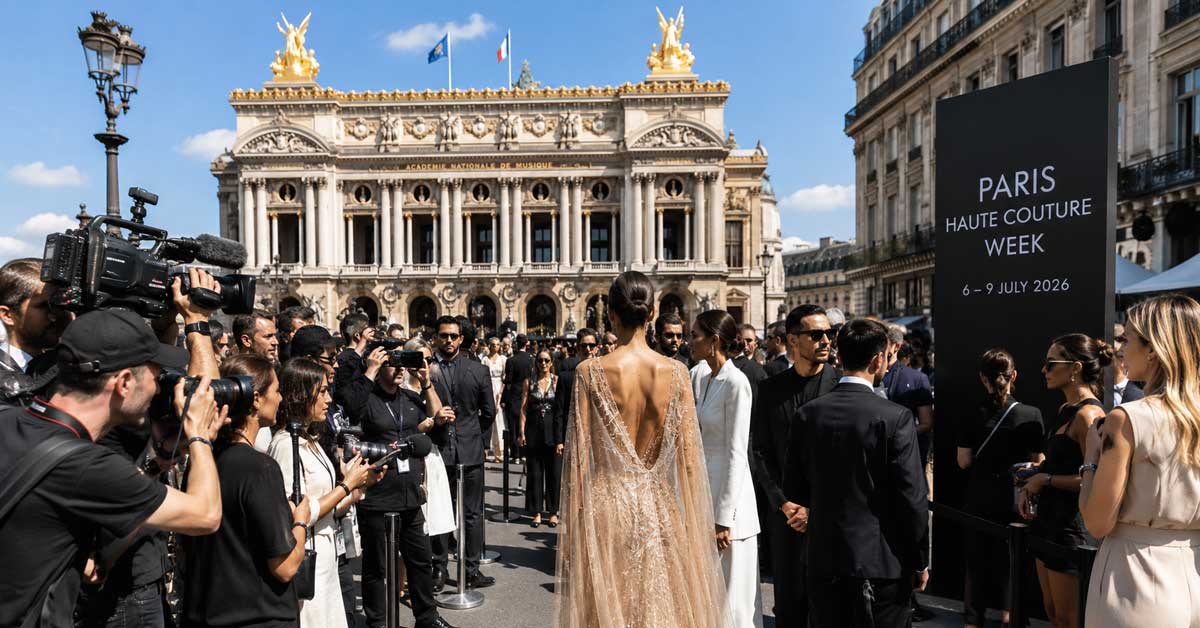
Quick Read
Paris is once again the centre of haute couture as the Autumn/Winter 2026–27 Haute Couture Week opens today. Beyond extraordinary garments, this season also reflects how the industry's communication strategy has changed. What was once an exclusive event hidden from cameras has become a carefully orchestrated global media production, where livestreams, films and digital storytelling play almost as important a role as the collections themselves.
• Paris Haute Couture Week opens today (6–9 July) with major creative debuts and returning couture houses. The week's most anticipated momentsInternational fashion media have identified several shows as the highlights of this edition. Much of the attention focuses on Jonathan Anderson's second haute couture collection for Dior, while Pierpaolo Piccioli presents his first couture collection for Balenciaga. Another closely watched debut is Duran Lantink's guest couture collection for Jean Paul Gaultier. The official calendar also marks the Paris haute couture debut of Indian designer Manish Malhotra, while Standing Ground joins the schedule as a guest house. Returning favourites include Schiaparelli, Chanel, Iris van Herpen, Elie Saab and Zuhair Murad.The Fédération de la Haute Couture et de la Mode (FHCM) distinguishes between live broadcasts and digital releases. Among the major livestreams are Christian Dior, Balenciaga, Jean Paul Gaultier, Elie Saab, Zuhair Murad and Manish Malhotra. Other highly anticipated presentations, including Schiaparelli, Iris van Herpen and Chanel, are released as professionally produced films shortly after the physical shows, allowing brands to control the visual presentation while reaching a worldwide audience. From secrecy to worldwide visibilityThe openness of today's couture week contrasts sharply with its early history. During much of the twentieth century, photography inside couture salons was heavily restricted. Fashion houses feared that competitors would sketch garments or reproduce designs before wealthy clients and licensed manufacturers had placed their orders. Even accredited photographers often worked under publication embargoes, with images released only after a waiting period.These restrictions were never solely about exclusivity. They also reflected the economic reality of couture. Before luxury brands generated significant revenue from accessories, beauty products and global licensing, couture collections themselves represented valuable commercial assets that required careful protection. Television, digital photography and later social media gradually changed that model. Instead of limiting visibility, fashion houses discovered that carefully managed exposure strengthened brand recognition. Today, millions of viewers can experience collections in real time without reducing the exclusivity of attending the show itself. Why copying is no longer the central concernAt first glance, livestreaming might appear to make copying easier. In reality, haute couture has developed other forms of protection.Many couture creations require hundreds or even thousands of hours of specialised handwork carried out by highly trained artisans. Embroidery, feather work, pleating, textile engineering and experimental manufacturing techniques are difficult to reproduce on an industrial scale. Designers such as Iris van Herpen, whose collections combine couture craftsmanship with advanced digital design and material innovation, illustrate how technical complexity itself can become a barrier to imitation. Legal protection has also evolved. While clothing designs can be difficult to protect through copyright alone, luxury houses increasingly rely on trademarks, registered designs, contracts, authentication technologies and digital product identities. Some brands now use blockchain-based certificates to document authenticity throughout a garment's lifetime, particularly for exceptional luxury pieces and the resale market. More than a runwayToday's Haute Couture Week is therefore more than a showcase of exceptional craftsmanship. It has become a global communication platform where invitation-only runway presentations coexist with livestreams, cinematic releases and digital technologies that protect authenticity while extending the reach of luxury brands.For readers wishing to follow the shows throughout the week, the official calendar published by the Fédération de la Haute Couture et de la Mode provides the most comprehensive overview of physical presentations, livestreams and digital releases. Annotation on 7 July Reading tip: WWD "Schiaparelli Fall 2026 Couture: Squid Game" Image: Photorealistic street scene in Paris during Haute Couture Week. Journalists, photographers, influencers and guests gather under summer sun as models arrive at a couture show venue. © Fashion.at / AI-generated with ChatGPT. |