
|
26 November 2026 Petar Petrov Brings Fashion and Art to Vienna’s Looshaus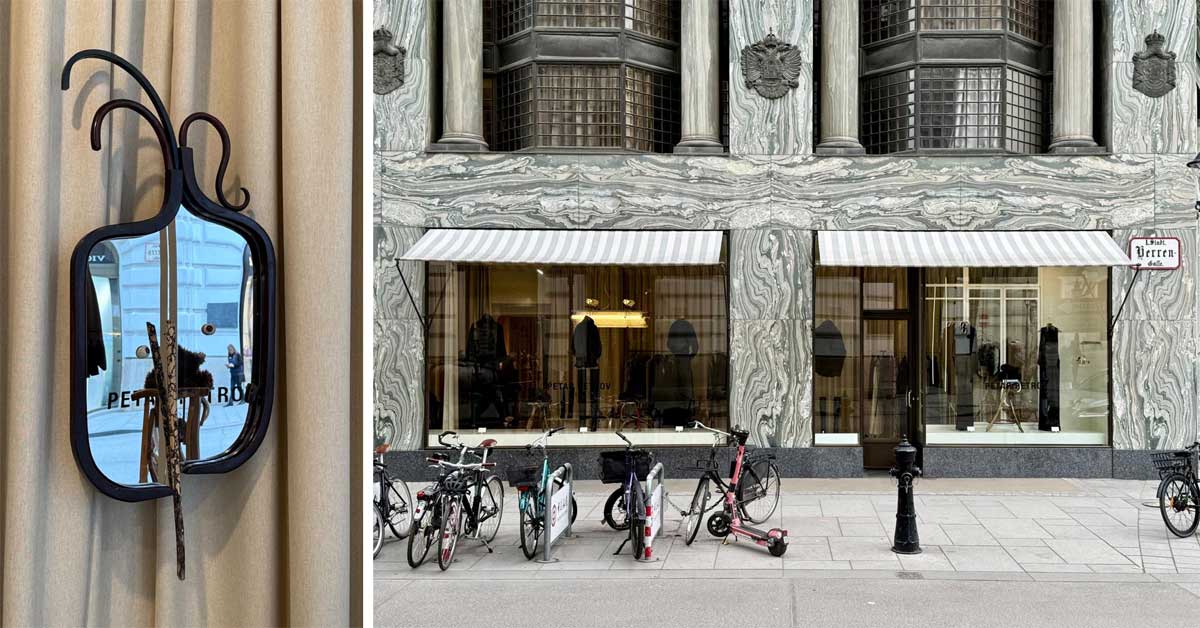
Quick Read
• Petar Petrov opens his first Vienna pop-up store on 26 November 2026, in the Looshaus at Michaelerplatz.
A pop-up with an artistic reflectionVienna's Advent season has gained an interesting new address. On 26 November, Austrian-based fashion designer Petar Petrov opens his first pop-up store in the Looshaus at Michaelerplatz. Running until the end of December, the temporary space combines a selection from his Autumn/Winter 2026 collection with contemporary art by the Viennese collective Gelitin. One of the preview images shows an unusual sculptural mirror, reflecting the Petar Petrov lettering in the opposite shop window and bringing the street into the artwork.When a mirror looks backGelitin consists of four artists: Wolfgang Gantner, Ali Janka, Florian Reither and Tobias Urban. The group has worked together since 1978 and officially began exhibiting under its collective name in 1993. Its practice ranges from sculpture and installation to performance, often involving humour, unexpected materials and the active participation of audiences. The mirror works have a particularly timely background. From 27 October to 7 November 2026, the gallery MASSIMODECARLO presented Gelitin Mirrors at its Pièce Unique space in Paris. The exhibition explored the mirror as more than a functional object: it reflects both the artwork and the person looking at it. Vanity, beauty, ambiguity and the limits of reality all enter the picture. In a fashion store, mirrors are usually part of the practical equipment. Here, they become artworks in their own right. They invite visitors to look at themselves, the clothes and the surrounding space from a different perspective. The reflection of the Petar Petrov name in the preview image makes this connection particularly tangible. Fashion becomes part of the artwork, while the viewer becomes part of the scene.Petrov meets Adolf LoosPetar Petrov was born in Ukraine, grew up in Bulgaria and moved to Vienna to study fashion at the University of Applied Arts, where his mentors included Viktor & Rolf and Raf Simons. He founded his womenswear label in Vienna in 2009. His designs are known for precise tailoring, fluid fabrics, distinctive proportions and a balance between masculine and feminine elements. Rather than following short-lived trends, his collections develop a modern, understated idea of elegance. In 2021, Petrov received Austria's Outstanding Artist Award for Experimental Fashion Design, awarded by the Federal Ministry responsible for arts and culture.The choice of location is not incidental. The Looshaus was designed by Adolf Loos (1870–1933), one of the pioneers of modern architecture in Austria. Built for the prestigious menswear company Goldman & Salatsch, the building was completed in 1912. Its restrained upper façade, without the decorative window surrounds customary at the time, caused considerable controversy. The nickname "House Without Eyebrows" captures the public reaction. Loos's preference for clarity, material quality and the rejection of superfluous ornament offers an interesting architectural counterpart to Petrov's precise approach to clothing. Both designers question the conventions of their respective disciplines. From menswear to jewelleryThe connection between the building and fashion also has a historical dimension. Goldman & Salatsch used the commercial floors for its tailoring business, making the Looshaus a fashion address long before the current pop-up. After several changes of use over the decades, the building has once again become home to retail. The Viennese jeweller Schullin has taken over large parts of the ground floor and mezzanine, combining watchmaking and fine jewellery with the architecture of the historic premises. Schullin's other Vienna boutiques, at Graben and Kohlmarkt, are also notable for their façades and nteriors designed by architect Hans Hollein.The new pop-up store adds a temporary fashion and art chapter to Adolf Loos' building. With Gelitin's artwork and Petrov's contemporary womenswear, the Loos Haus — one of Vienna's most recognisable architectural landmarks — promises to be the setting for one of the most interesting retail interventions this Advent season. |