
|
15 September 2026 Four Women, Four Ways of Making Jewellery in Vienna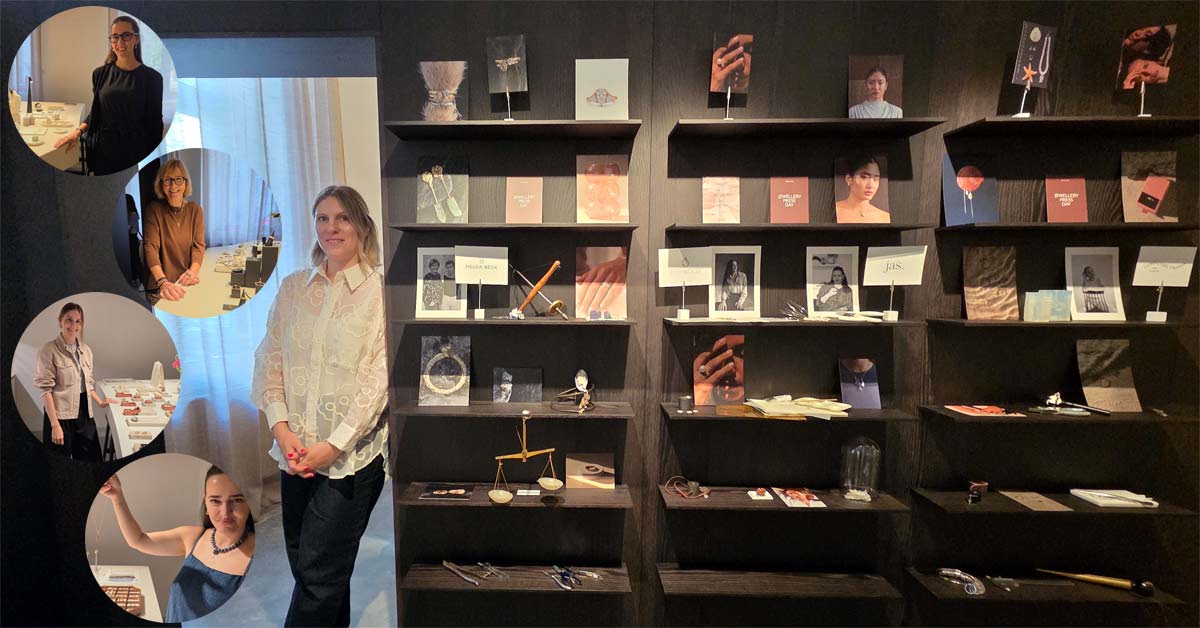
Quick Read
• A Vienna press appointment brought four women-led jewellery businesses together around craft, materials and personal design.
A room full of jewellery, and very different storiesAt the press appointment attended by Fashion.at, the setting was as interesting as the objects on display. Journalists, influencers and jewellery professionals moved through the Less Is More Open Lab in Vienna, stopping at four presentations that had little in common stylistically. What connected them was more basic: each business was shaped by a woman and by a close relationship between design and making.The event was organised by Ambre Azur, a Vienna-based boutique consultancy founded by Birgit Marie Herold-Schmidt and specialising in strategy, brand development and PR for fine and demi-fine jewellery labels. The agency has positioned itself around the stories and creative processes behind jewellery rather than simply presenting finished products. Less Is More provided the surroundings, but jewellery was clearly the main subject. The Vienna company is known for certified organic haircare and skincare developed by chemist and co-founder Dr. Doris Brandhuber together with hairstylist Hannes Trummer. Its philosophy is built around reducing products to what is considered essential. On this particular afternoon, apart from a travel-sized shampoo appearing almost incidentally, the beauty label remained in the background. Lili Koos: jewellery as a family languageLili Koos represents the longest connection with jewellery craftsmanship among the four. The Hungarian-born jeweller is a fourth-generation member of a family whose jewellery history began more than a century ago in Budapest. She was also included in Forbes' 30 Under 30 list in 2017. After periods in London, Sydney and Italy, she established her creative base in Vienna.Her approach is less about jewellery as a visible status marker than as something that becomes part of its wearer. At the presentation, organic shapes and pearls made this particularly apparent. One of the ideas shown was to work around the natural form of a pearl instead of forcing the stone into a perfectly regular setting. The result is a ring in which the irregularity of nature becomes the starting point of the design. This attitude also appears in her wider work: gold, light, skin, gemstones and pearls are treated as elements of a composition rather than as separate signs of luxury. Her pieces are handcrafted, with individually selected stones set by hand. Helga Beck: from branch to raw diamondAt Helga Beck, nature enters jewellery in a much more visibly rugged form. The Vienna label is a mother-and-daughter goldsmith collective: Helga began working with metal decades ago and later trained as a goldsmith; her daughter Victoria joined the business, taking responsibility for areas including communications and the website. Today, the design work is a collaboration between the two.Their pieces often look as if fragments of the natural world have been translated directly into metal. Branches, broken twigs and irregular surfaces become the basis for rings and other forms. Raw diamonds are not necessarily polished into conventional brilliance; their original character can remain visible. Gold and silver are also manipulated through different techniques, including sand casting. The result is deliberately uneven rather than perfectly uniform. Helga Beck also works across gender categories, offering unisex pieces and men's jewellery such as signet rings. All pieces are made by hand in Vienna, with recycled or fairly sourced precious metals forming part of the label's material approach. Gold Coast Vienna: science, custom work and a second lifeTamara Epple took a less conventional route into jewellery. A trained biologist, she completed her gold- and silversmith training in 2022 and founded Gold Coast Vienna after a trip to Australia, which also inspired the name. Her work brings together scientific curiosity and the physical craft of jewellery making.Laboratory-grown diamonds are part of her material vocabulary, but another important aspect is what happens to jewellery that already exists. Epple offers to redesign old gold, silver or platinum jewellery, turning inherited or unused pieces into something for a new wearer. The process can involve preserving the existing metal or recycling it into a new design. Her own collections move between organic and geometric ideas, while custom work includes engagement and wedding rings. Each piece is made individually in her Vienna studio rather than produced as an anonymous series. jas. jewelry: architecture meets the language of waterJasenka Dogan came to jewellery from architecture. That background is still visible in her approach: structure, proportion, function and durability are transferred from buildings to objects worn on the body.For the presentation, water and its sense of lightness provided the central theme. Among the pieces were fish-shaped pendants and a necklace designed to become a changing personal object. The Bond Necklace, for example, is built from interlocking links and can be extended with charms, allowing the wearer to alter its appearance over time. The meeting in the Open Lab therefore became less a parade of similar jewellery than a small cross-section of Vienna's independent jewellery scene. Four women, four biographies and four different ways of turning material into something personal: inherited craft, natural irregularity, scientific curiosity and architectural structure. For the visitors in the room, the interesting part was not only what was lying in the display trays, but hearing how differently each maker arrived there. Images: Portraits of Lili Koos, Helga Beck, Tamara Epple of Gold Coast Vienna and Jasenka Dogan of jas. jewelry. Ambre Azur founder Birgit Marie Herold-Schmidt stands beside a display presenting work and visual material from four Vienna-based jewellery businesses at the Vienna press presentation, 15 September 2026. © Fashion.at |