
|
29 July 2026 The First School Bag: What Really Matters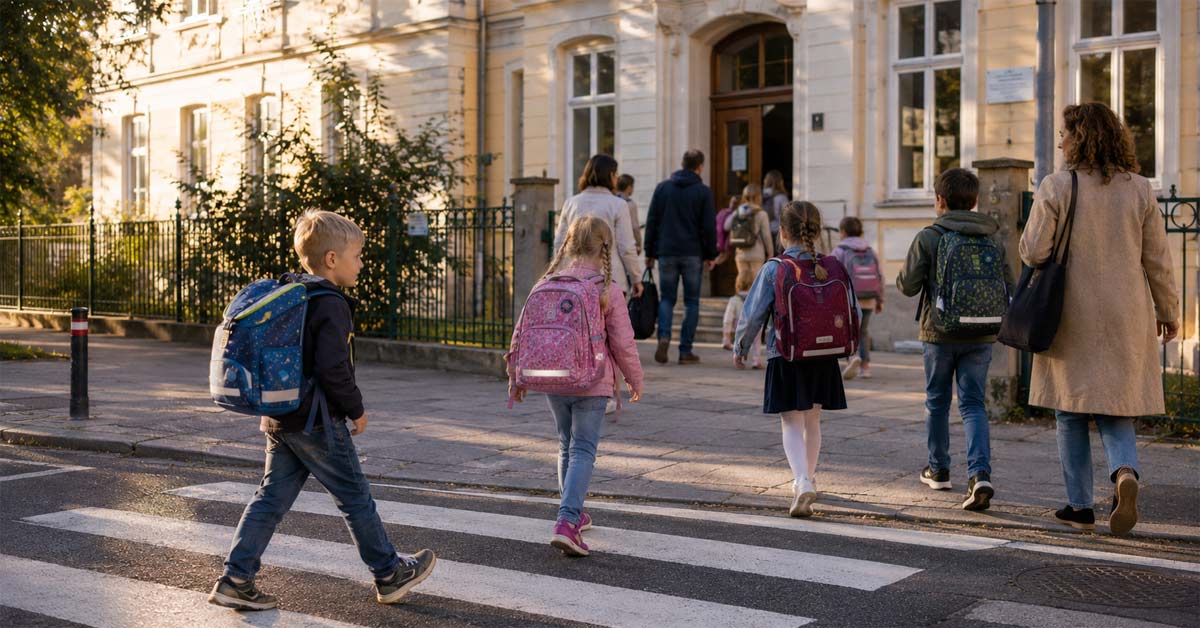
Quick Read
For generations, the first school bag has symbolised far more than the beginning of a new school year. It represents a child's first independent journey into education. In Austria, that journey has been closely connected with compulsory schooling for more than 150 years. Today, while colourful designs may capture children's attention, consumer testing shows that comfort, visibility and safety remain the qualities that matter most.
• Austria's school bag has a long history linked to compulsory education and equal access to learning. From compulsory education to equal opportunitiesAustria introduced compulsory primary education through the Reichsvolksschulgesetz of 1869, a reform driven by industrialisation, literacy and the growing need for an educated population. At the time, the change was not universally welcomed. Many farming families depended on children as workers, while schooling meant additional expenses and less help at home.Over the following decades, however, education gradually became recognised as one of society's strongest engines of social mobility. Numerous educational studies, including OECD PISA research, have consistently shown that children who enjoy school and feel they belong are more likely to remain engaged in learning and achieve better educational outcomes. At the same time, research also demonstrates that children from socio-economically disadvantaged families often report lower school satisfaction unless schools actively create supportive learning environments. Austria has responded with measures such as additional resources for socially disadvantaged schools, expanded all-day schooling, school social workers and targeted support programmes designed to reduce educational inequality. The underlying idea is simple: when children experience school as a place where they can succeed, motivation tends to grow alongside opportunity. One could argue that the philosophy behind today's school system and a well-designed school bag share something in common. Both aim to support mobility. One helps children move safely through traffic. The other helps them move confidently through education without being left behind. How the school bag evolvedSchool bags became widespread in Austria during the late nineteenth century, inspired by military backpacks that offered a practical way to carry books, writing materials and later exercise books over increasingly longer school journeys. During the 1970s, traditional leather satchels gradually gave way to lighter textile and synthetic models, while ergonomics increasingly became an important design consideration.Today's school bags are expected to do much more than transport books. They distribute weight evenly across a child's back, protect school materials from rain, improve visibility in traffic and adapt to growing bodies over several school years. Why the VKI test mattersThis is where the Verein für Konsumenteninformation (VKI) plays an important role in Austria. As the country's leading independent consumer organisation, the VKI carries out comparative product testing, legal consumer protection work and market research. Its activities are financed through a combination of publication sales, subscriptions to its magazine KONSUMENT, paid advisory services and public funding for consumer protection activities. Importantly, the organisation does not accept commercial advertising or corporate sponsorship for its testing activities, helping preserve its independence.On 29 July, the VKI released an advance overview of its latest school bag comparison ahead of the publication of the complete results in the new issue of KONSUMENT. The comparative test examined 13 school bags for primary school children, evaluating ergonomics, durability, waterproofing, usability, visibility and everyday practicality. Good overall results, but visibility needs attentionThe encouraging headline from the latest VKI comparison is that none of the 13 tested school bags scored below an overall "average" rating. Most models achieved a "good" overall result, indicating that manufacturers have made significant progress in ergonomics, durability and everyday usability.The greatest differences appeared in one area that parents cannot easily judge at first glance: visibility in road traffic. Seven of the 13 tested models lost points because they offered too little fluorescent material for daytime visibility or insufficient reflective surfaces for darkness. According to the VKI, one of the weakest performers in this category was the tested Lego Ninjago model, although its overall assessment still remained "average." Price also proved not to be the sole indicator of quality. While many complete school bag sets now cost around €300, the VKI found that less expensive alternatives can also perform well. The tested Oxybag model was named the price-performance winner, combining low weight with good everyday usability. However, it also showed weaker performance in visibility and only average water resistance. One of the strengths of the VKI comparison is that it combines laboratory testing with real-life experience. Around one third of the final rating came from practical assessments by children aged six to eight, who evaluated comfort, fit, ventilation, accessibility of compartments and ease of handling with both partially and fully loaded school bags. Technical experts additionally examined durability, waterproofing, workmanship, storage space and visibility from different distances under simulated traffic conditions. The result is more than a simple ranking. It offers parents practical guidance on which characteristics deserve attention before making what is often a significant purchase. Buying new—or considering second-hand?Although a school bag is often viewed as a once-in-primary-school investment, it is also one of the products increasingly found on second-hand marketplaces. Because many high-quality ergonomic models are designed to last several years, purchasing a carefully maintained used school bag can reduce costs while extending the product's useful life.When buying second-hand, however, parents should carefully inspect shoulder straps, buckles, padding, back support and waterproof coatings. Reflective materials may also have deteriorated over time. If visibility is limited, inexpensive reflective accessories, clip-on reflectors or fluorescent rain covers can significantly improve safety. Choosing the right school bag: one size never fits allPerhaps the most valuable message from the VKI is that there is no universally perfect school bag. The best model is the one that fits the individual child.Before purchasing, parents should consider several practical points: • Let the child try different models with realistic weight inside. • Ensure the bag sits close to the back, with the upper edge near shoulder height and the lower edge above the hips. • Choose wide, padded shoulder straps together with a chest strap and, ideally, a hip belt for better weight distribution. • Look for sufficient fluorescent and reflective surfaces; additional reflectors can improve safety if necessary. • Prefer lightweight models with a stable, water-resistant base and practical compartment organisation. • Check that zippers, buckles and closures can easily be operated by the child independently. Ultimately, the first school bag is more than a fashion accessory. It accompanies children during one of the most important transitions in their lives. While a comfortable, well-designed bag cannot determine educational success, it can make the daily journey a little easier, a little safer and perhaps even a little more enjoyable. In that sense, the latest VKI test offers more than product ratings—it provides practical guidance for one of childhood's most memorable milestones. Image: Children arrive at an Austrian primary school carrying modern school bags with ergonomic shoulder straps and reflective safety elements. The editorial image illustrates the importance of comfort and visibility. © Fashion.at, AI-generated with ChatGPT |