
|
22 October 2026 Cleopatra’s Rival, a Roman Murder Mystery and the Rise of Egyptian Style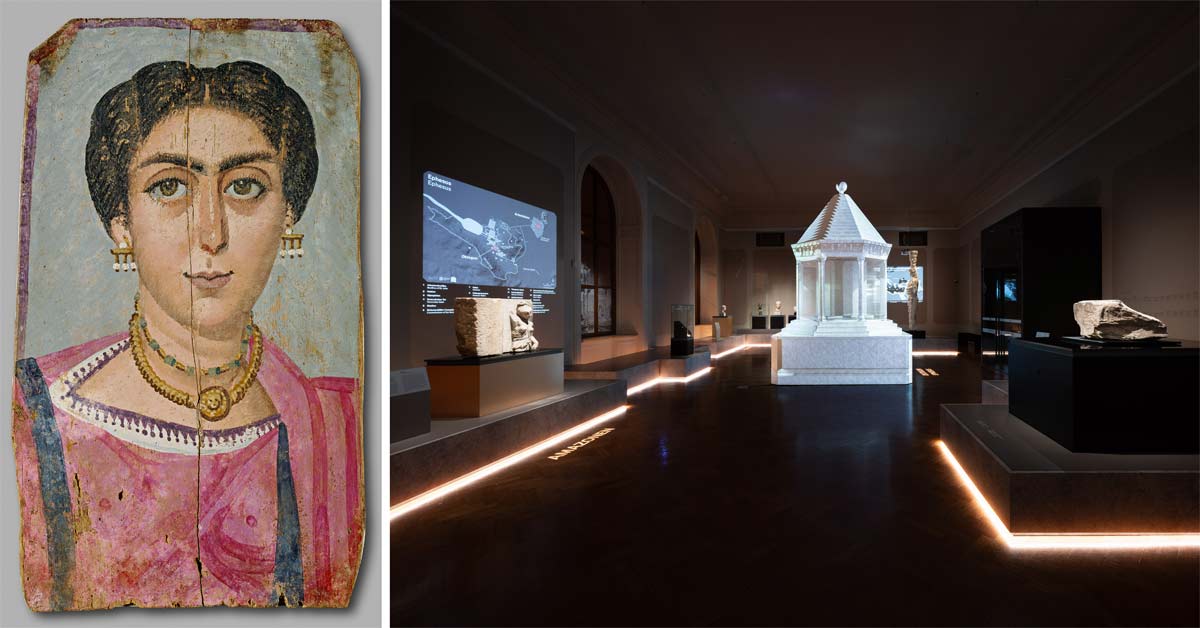
Quick Read
• The Kunsthistorisches Museum's exhibition Crime Scene Ephesus. Cleopatra and Rome turns an ancient murder story into a journey through archaeology, political power and cultural exchange. A murder mystery opens the storyLove, rivalry, political alliances and death: the story behind Crime Scene Ephesus. Cleopatra and Rome has the ingredients of a historical crime drama. Yet the exhibition at the Kunsthistorisches Museum (KHM) in Vienna begins with a question archaeology cannot simply answer: who was buried in the mysterious Octagon at Ephesos, in present-day Türkiye?The story leads back to the first century BC, when Cleopatra VII fought to preserve her kingdom against Rome. Her younger sister Arsinoë IV became a rival during the Alexandrian War of 48–47 BC. After Julius Caesar's victory, Arsinoë was taken to Rome and later exiled to Ephesos. Ancient sources report that she was killed there in 41 BC. The political circumstances have encouraged the suspicion that Cleopatra was involved, but the full circumstances of the murder remain uncertain. The exhibition uses this unresolved historical story as its starting point, before widening the view to the political and cultural transformations of the ancient Mediterranean. The Octagon: a historical cold caseThe Octagon is an unusual, monumental, eight-sided tomb discovered by Austrian archaeologists in Ephesos in 1904. Its prominent location and architectural features suggested that it was intended for a person of high status. The upper structure has also been compared with the lighthouse of Alexandria, which included an octagonal section.When a sarcophagus was investigated in 1929, human remains were found inside. For decades, the idea that they belonged to Arsinoë IV offered a compelling link between the tomb and Cleopatra's family. However, scientific research published in Scientific Reports in January 2025 changed the picture. Analyses identified the individual as a boy aged approximately 11–14, probably with ancestry from the Italian peninsula or Sardinia. The identification as Arsinoë can therefore be excluded. The fate of Cleopatra's sister remains unknown. This finding is essential to understanding what "Crime Scene Ephesos" means. The title refers not to a solved murder case, but to a place where archaeological evidence, historical accounts and scientific testing meet. The Octagon still raises questions about the identity and background of the person buried there, even though one of the most persistent theories has been disproved. An audio drama turns visitors into image-makersThe exhibition's five-room route is accompanied by an audio drama available through the KHM app. Developed with Theresa von Eltz, whose work includes film direction and dramaturgy, it uses seven voices, dialogue and sound effects to connect the objects into a continuous narrative.Cleopatra and Arsinoë appear as opposing sisters; researchers examine the evidence; an Egyptian priest introduces religious perspectives; Aristotle evokes the intellectual world of Hellenistic antiquity; and a messenger from Ephesos reports on the developing investigation. The story moves from Ephesos to Alexandria, through the Ptolemaic dynasty and Cleopatra's Roman alliances, and finally to the rise of Augustus. The original objects supply the material evidence, while the audio drama provides scenes, characters and possible connections. Visitors can construct their own mental images of the past rather than receiving a single, fully illustrated version of events. How convincing or absorbing the experience becomes depends partly on each visitor's willingness to listen, look closely and connect the clues. The dramatic framework is provided, but the imagination completes the journey. From Cleopatra's Egypt to Rome's new fashionThe final room shifts the focus from political conflict to cultural influence. Egypt became a Roman province in 30 BC, after Octavian defeated Cleopatra and Mark Antony. Octavian later ruled as Augustus, the first Roman emperor. The conquest ended the Ptolemaic dynasty, but Egyptian culture did not disappear from the Mediterranean world.Instead, Egyptian gods, religious practices, artistic motifs and luxury objects found new audiences in Rome. Obelisks and Egyptian-style sculpture became part of public and private settings, while the cult of Isis spread beyond Egypt. Roman patrons also adopted and reinterpreted Egyptian visual forms. The result was not simply the import of foreign objects: Egyptian traditions acquired new meanings within Roman society. The exhibition brings this cultural shift into view through objects ranging from sculptures and carved gemstones to painted mummy portraits. One example is the portrait of a woman wearing a necklace, painted in encaustic on wood between AD 161 and 192. Its combination of Egyptian funerary tradition and a recognisably individual portrait reflects the cultural complexity of Roman Egypt. With around 100 objects, including international loans, the exhibition links an unresolved burial mystery to a wider history of power, identity and cultural exchange. Its central tension remains productive: the audio drama gives the past a voice, while archaeology establishes what can—and cannot—be said with confidence. |