
|
20 August 2026 Austria’s Health Lifestyle: More Control, Less Interest in Trends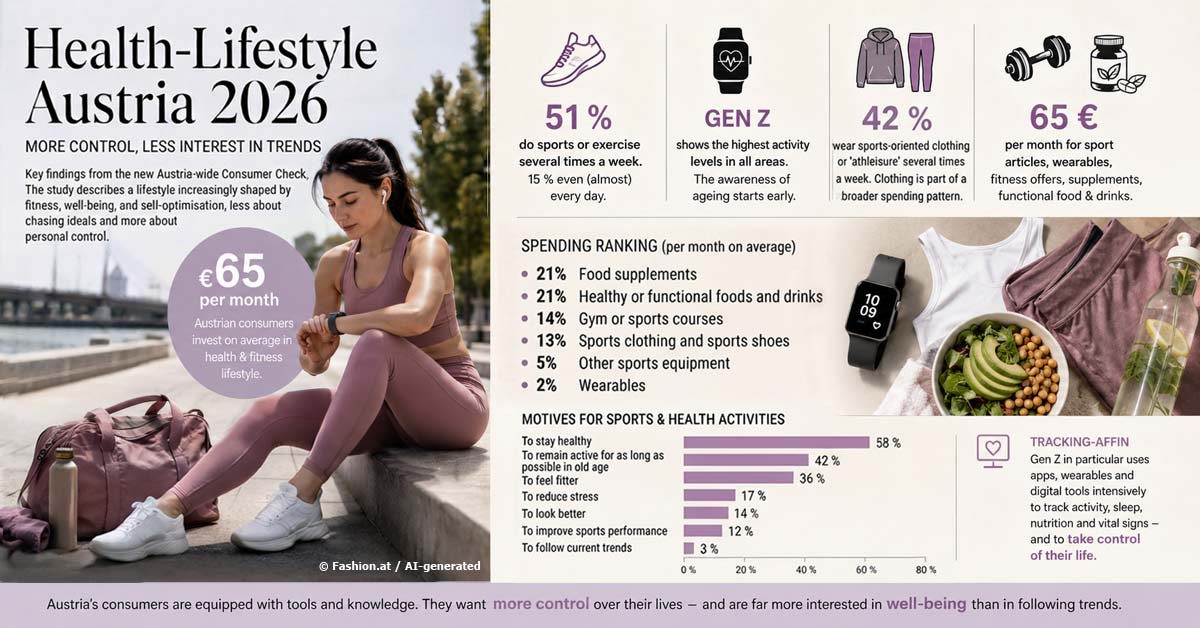
Quick Read
The latest HV Consumer Check "So kauft Österreich" points to a consumer who is increasingly interested in managing health, fitness and ageing on their own terms. The study was conducted by Reppublika Research & Analytics on behalf of the Handelsverband in Austria from 5 to 11 August 2026, surveying 1,009 people aged 18 and over by CAWI. The sample is representative of the Austrian population. The results on the health-lifestyle trend were presented today, 20 August.
• €65 a month: That is the average amount Austrians spend on the health-lifestyle areas surveyed by Handelsverband. (According to Statistics Austria, per capita spending by a household amounts to approximately 2,760 euros per month.) From fitness to a wider lifestyleThe Handelsverband is the Austrian association representing retail companies. It describes itself as an independent, voluntary and non-partisan organisation and has operated as an interest group and innovation platform since 1921. Its members represent a large share of the Austrian retail market. Its latest Consumer Check describes a lifestyle increasingly shaped by fitness, wellbeing and self-optimisation. The language around it has become familiar: longevity refers to the ambition to remain healthy and active for as long as possible; biohacking means deliberately adjusting aspects of lifestyle such as nutrition, training or sleep; looksmaxxing focuses more specifically on systematically improving appearance. The Austrian findings, however, suggest that the reality is less about chasing an ideal image than the terminology might imply. 51% exercise or engage in targeted physical activity several times a week, including 15% who do so almost daily. Only 7% say they are never physically active.When sportswear becomes everyday clothingThe shift is also visible in fashion. Athleisure – the combination of "athletic" and "leisure" – describes sports-oriented clothing moving beyond training into ordinary life. According to the Consumer Check, 42% wear such clothing several times a week. Clothing is part of a broader health-lifestyle spending pattern. On average, Austrians spend €65 per month on the areas covered by the survey: sport clothing and equipment, wearables, fitness services, supplements, and functional foods and drinks.Asked which of these areas they currently spend the most on, the ranking is: • 21% – food supplements • 21% – healthy or functional foods and drinks • 14% – gyms or sports courses • 13% – sports clothing and sports shoes • 5% – other sports equipment • 2% – wearables The figures show how the health economy crosses traditional retail boundaries: fashion, food, sport, technology and services increasingly meet within the same consumer routine. Health beats the trendThe most revealing part of the results is perhaps not what people buy, but why they do it. The motives, listed from the least frequently cited to the strongest, are:• 3% – to follow current trends • 12% – to improve sports performance • 14% – to look better • 17% – to reduce stress • 36% – to feel fitter • 42% – to remain active for as long as possible in old age • 58% – to stay healthy The result puts a clear distance between self-optimisation and trend-following. Social media may popularise words such as longevity, biohacking and looksmaxxing, but only a small minority of respondents say that following trends is a reason for their own activities. Gen Z and the idea of taking controlAge already appears to be an important factor. The Consumer Check's Gen Z respondents are particularly active in this field, spending around €90 per month on the surveyed health-lifestyle areas – considerably more than the €65 population average. The group is also described as particularly tracking-affine. In practical terms, this means a stronger willingness to use apps, wearables and other digital tools to monitor activity, sleep, recovery or other aspects of personal wellbeing. That detail points to a broader change in the consumer role. Tracking does not simply mean collecting data; it can also mean trying to take control – observing one's own behaviour, identifying patterns and using available tools to develop personal strategies.The emerging picture is therefore less about consumers passively following the next lifestyle trend and more about people using an expanding set of tools and possibilities to make decisions for themselves. The consumer is becoming more informed, more data-equipped and more interested in personal outcomes than in simply keeping up with what is fashionable. In that sense, self-optimisation may be less a story about following trends than about consumer emancipation: having more options, more information and, at least in some areas of life, more control. Image: Austrian health-lifestyle trends in 2026: fitness, athleisure, wearables and self-optimisation, based on the Handelsverband Consumer Check. © Fashion.at / AI-generated |