
|
4 November 2026 Women, Work and Craft: Birke Gorm Wins the 2026 Otto Mauer Prize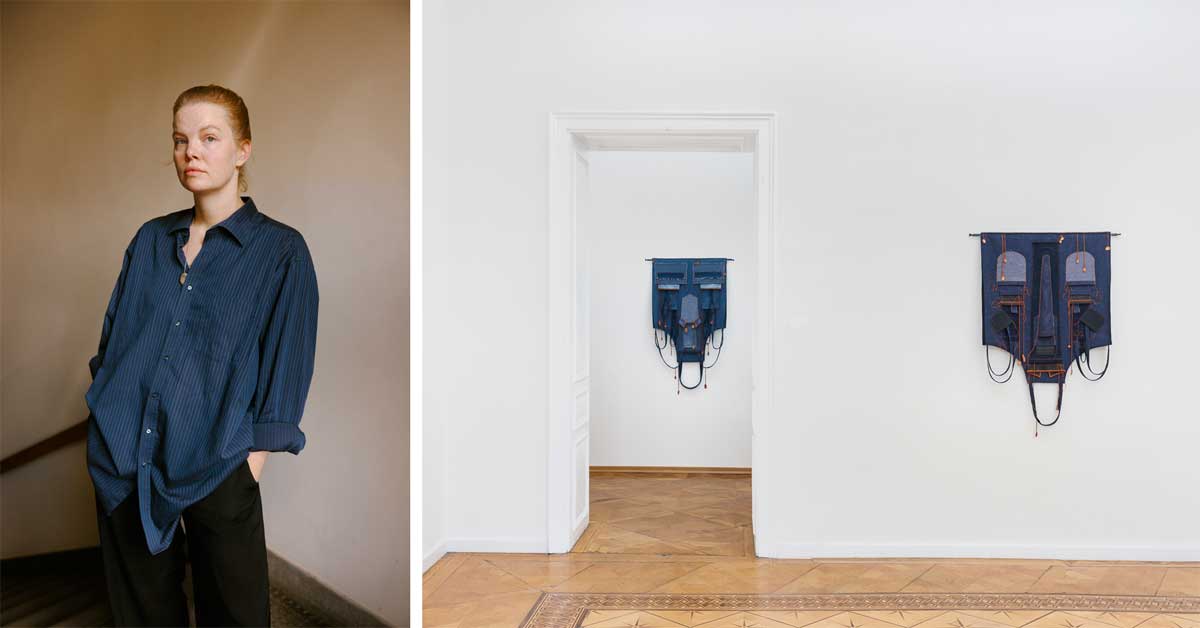
Quick Read
• German-Danish artist Birke Gorm, who lives and works in Vienna, has received the 46th Msgr. Otto Mauer Prize for 2026.
Making invisible work visible through artBirke Gorm's work begins with materials that are often overlooked: discarded textiles, jute, cardboard, terracotta, pieces of wood and rusty metal. She collects, sorts and reworks these objects, combining them in sculptures and installations that move between abstraction and figurative forms. Some resemble bodies or human figures, while others create unusual relationships between objects and the surrounding space. Her choice of materials is closely connected to the subjects she addresses. They carry traces of previous use and the labour involved in their production, handling and repair. Through techniques such as sewing, weaving, stitching and mending, Gorm gives them a new context without concealing their history.The craft techniques are significant in their own right. Traditionally associated with domestic work and women's activities, sewing and repairing have often been treated as everyday duties rather than recognised forms of labour. Much of this work remains unpaid and is rarely reflected in conventional measures of economic value. Gorm uses these techniques to question the distinction between productive and supposedly less valuable work. Her approach has a clear feminist dimension, but it goes beyond a straightforward reference to women's crafts. She examines the social and economic structures that determine whose work is visible, whose contribution is recognised and which materials are considered valuable. The jury recognised this connection between artistic practice and social criticism, describing her work as an examination of social hierarchies, labour and gender relations. Born in Hamburg in 1986, Gorm studied textile design at the Kolding School of Design in Denmark, painting at the University of Fine Arts in Hamburg and fine arts at the Academy of Fine Arts Vienna, where she graduated in 2018. She lives and works in Vienna. Her recent exhibition history includes presentations at the MAK in Vienna, O—Overgaden in Copenhagen and the 2026 Lyon Biennale. She is also participating in the 2026 Gwangju Biennale in South Korea. From Erwin Wurm to a growing number of women artistsThe Msgr. Otto Mauer Prize has been awarded annually since 1981. It recognises an artist's overall body of work rather than a single project. Over four decades, it has become an important distinction in Austrian contemporary art and has often provided a springboard for further institutional and international recognition. The list of recipients includes many influential names. Erwin Wurm received the award in 1984, Gunter Damisch in 1985, Franz West in 1986, Lois Renner in 1992 and Heimo Zobernig in 1993. Other recipients include Dorit Margreiter, Esther Stocker and Peter Kogler. Looking back at the history of the award also reveals how strongly men dominated its early years. Women were present from the beginning, with Brigitte Kowanz receiving the prize in 1989 and Maria Hahnenkamp in 1995, but their representation remained comparatively limited. In recent years, women artists have become more visible among the recipients: Katrin Hornek (2021), Maruša Sagadin (2022), Belinda Kazeem-Kamiński (2023) and Cäcilia Brown (2024) preceded Gorm. This development is relevant beyond the question of representation. The recent recipients have brought different perspectives on identity, social structures, the environment and the conditions of contemporary life into the history of the award. Gorm's examination of invisible labour and gendered craft traditions adds another perspective to this conversation.Otto Mauer: a priest who opened the door to avant-garde artThe award commemorates Monsignor Otto Mauer (1907–1973), a Catholic priest, theologian and committed supporter of contemporary art. Monsignor is an honorary ecclesiastical title granted to a priest by the Pope. In 1954, he founded the Galerie St. Stephan in Vienna's Grünangergasse. At a time when abstract and experimental art encountered considerable resistance, Mauer provided artists with an exhibition space and a platform for discussion. The gallery became an important meeting place for the post-war Austrian avant-garde, presenting artists including Arnulf Rainer and members of the so-called St. Stephan Group.The Otto Mauer Fonds was established in 1980 by Cardinal Franz König and Prälat Karl Strobl, heir to Mauer's estate. The first prize followed in 1981. Its purpose is to continue Mauer's commitment to the dialogue between Church, art and science. In addition to the annual award, the Fonds supports projects in visual art, science and adult education. Prize ceremony at the Archbishop's Palace, exhibition at JesuitenFoyerThe 2026 award ceremony will take place on 19 November at 7.30 pm at the Erzbischöfliches Palais, Wollzeile 2, Vienna. General Vicar Andreas Kaiser will present the award. Johanna Schwanberg, director of the Dom Museum Wien and chair of this year's jury, will introduce the artist. Attendance is limited and requires advance registration. The ceremony is therefore not a public event with unrestricted admission.The prize includes €15,000. In addition, the Otto Mauer Fonds will acquire a representative work by Gorm for the Otto Mauer Collection at the Dom Museum Wien. The award also includes an exhibition of selected works by the artist. This exhibition will take place at the JesuitenFoyer, Bäckerstraße 18, 1010 Vienna. It runs from 17 December 2026 to 29 January 2027. The opening is scheduled for 16 December at 6 pm. Admission is free. |