
23 March 2026 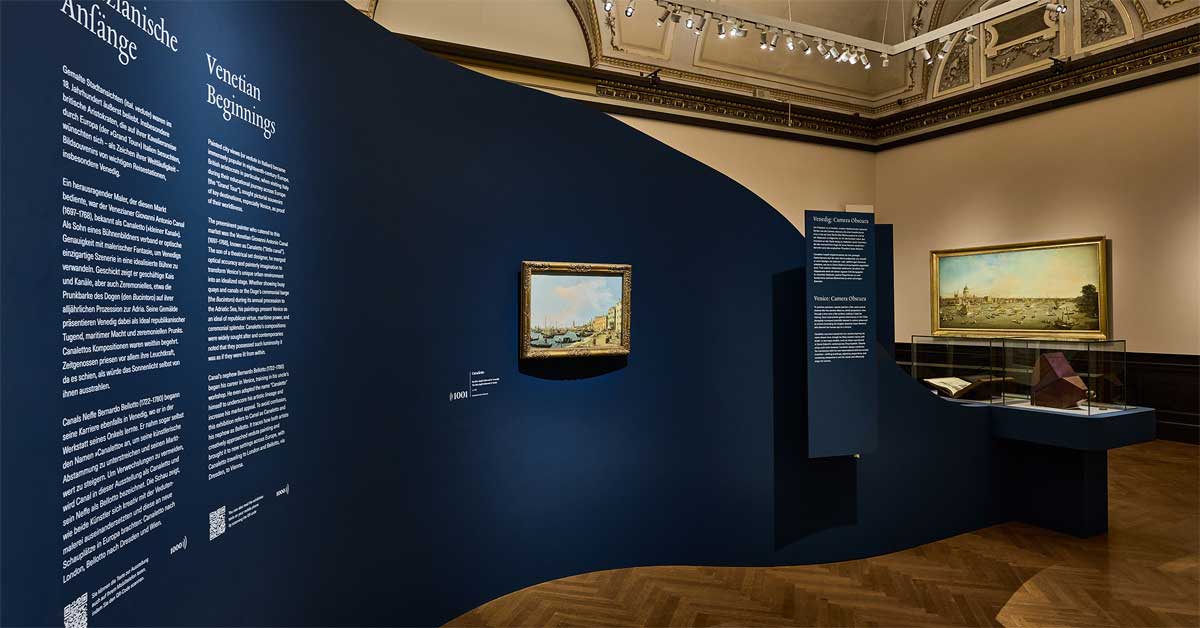 Physics, Observation, and the EyeThe rise of modern physics in the 17th and 18th centuries changed how people understood the world. Thinkers such as Isaac Newton studied light, optics, and perception, while philosophers like Gottfried Wilhelm Leibniz and Denis Diderot explored how knowledge is formed through observation. These ideas did not remain in science alone. They also influenced art—especially painting that aimed to represent reality with precision.At today's press conference for the exhibition "Canaletto & Bellotto" at the Kunsthistorisches Museum, it became clear how deeply these scientific developments shaped artistic practice. Optics and the Camera ObscuraOne of the central themes of the exhibition is the use of optical tools, especially the camera obscura. This device projected an image of the outside world onto a surface, allowing artists to trace perspectives with high accuracy. Canaletto used such instruments from the 1720s onward, not as a mechanical shortcut, but as part of a broader intellectual engagement with empirical science.The exhibition catalogue dedicates significant space to this topic, explaining how optical instruments were discussed in scientific and philosophical texts of the time. The camera obscura became a symbol of a new way of seeing: the world as something measurable and observable. However, the exhibition also shows that Canaletto did not depend entirely on the device. He adjusted perspectives, changed proportions, and even combined multiple viewpoints. The result is not a direct copy of reality, but a constructed image shaped by artistic decisions. Empirical Realism in ViennaThis balance between measurement and invention becomes even clearer in the works of Bernardo Bellotto. During his stay in Vienna, Bellotto applied methods similar to those used by cartographers. He worked from elevated viewpoints and used techniques comparable to triangulation, aligning buildings through measured reference points.His paintings reflect what can be described as "empirical realism": a visual language that combines scientific observation with artistic composition. The exhibition texts connect this approach to the Enlightenment, where mapping, measuring, and cataloguing the world became central cultural practices. At the same time, Bellotto's works follow a philosophical idea described by Leibniz: reality is understood through multiple perspectives. His views of Vienna are not one complete image, but a series of partial observations forming a larger whole. Between Accuracy and StagingDespite their precision, the paintings are not neutral documents. Both artists staged their cities. Buildings are repositioned, proportions adjusted, and everyday tensions often removed. The exhibition texts explicitly note that these images present an idealized world, sometimes without its social conflicts.This aesthetic choice can be seen as a limitation. Like in Canaletto's London views, critics already in the 18th century pointed out that such images gloss over social realities. The beauty of the scenes may therefore also be understood as a constructed illusion. From 18th-Century Optics to AIThe exhibition links historical techniques with contemporary digital tools. In one room, an installation animates selected views of Vienna using AI. Maps, narrative sequences, and Bellotto's working methods are brought together to demonstrate how measured viewpoints and empirical data can be transformed into dynamic visual experiences. What appears static in painting is reinterpreted as a process—constructed, layered, and in motion. Additional touch screens allow visitors to examine individual works more closely and access further contextual information.In the final section, interactive stations extend this exploration in a more playful way. Two multimedia games are designed especially for younger audiences. They encourage careful observation of people, everyday life, and architecture by asking visitors to identify subtle inconsistencies within the digitally manipulated images—for example, an anachronistic detail such as a figure using a smartphone. Other activities invite users to actively compose their own scenes, introducing the principles of staging through hands-on engagement. The printed catalogue expands on these technical aspects in depth. Whether one reads it before or after visiting the exhibition makes little difference. However, reading it afterwards may be more rewarding, as the memory of the paintings—and their carefully staged atmospheres—returns vividly. Fashion.at attended the press conference and found that the exhibition offers not only art historical insight but also a reflection on how images are constructed—then and now. The exhibition runs from 24 March to 6 September 2026. A video presentation is currently in production and will be published on the museum's YouTube channel. Image: Exhibition view at the Kunsthistorisches Museum Vienna showing an 18th-century camera obscura and a painting by Canaletto. © KHM-Museumsverband, Photo: Jakob Gsöllpointner |