
29 January 2026 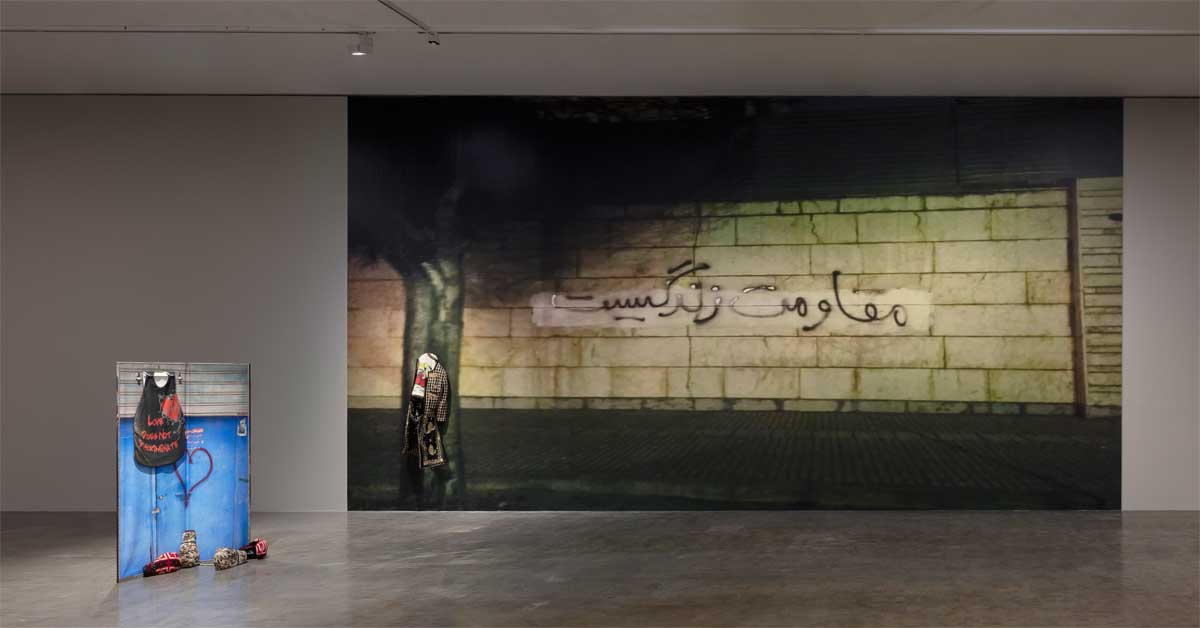 Fashion, Body and PoliticsOn 28 January 2026, fashion.at attended the artist talk with Chalisée Naamani at Kunsthalle Wien, held shortly before the opening of her exhibition Octogone. The conversation took place between the artist and Noit Banai, Professor for Diaspora Aesthetics at the Academy of Fine Arts Vienna, and was conducted in English.In the talk, Naamani addressed the political dimension of fashion and the body, with a brief reference to the current situation in Iran. "Fashion is political. The body is political," she said, situating her work in a context where appearance, movement and self-expression are closely linked to power and control. The exhibition marks Naamani's first major solo show outside of France. Prior to its opening in Vienna, there was an artist talk that framed the works through questions of diaspora, resistance, and cultural continuity. Diaspora as Layered ExperienceBanai began the discussion with reflections on diaspora aesthetics, describing it as an experience shaped by departure, displacement and multiple forms of belonging. Against common expectations of exile as rupture or fragmentation, Naamani appeared as an artist whose world is not divided but composed of layered cultural realities. Persian, European and American references coexist in her practice, not as opposites but as accumulated experiences.Rather than presenting diaspora as loss, Naamani described it as a condition of awareness: an understanding that cultural traditions are not erased, but continue to exist under pressure and can re-emerge through struggle. Her work reflects this persistence through material layering, printing, assembling and re-contextualising images and objects. Octogone, Movement and MemoryThe exhibition title Octogone refers to the octagonal training space of the Zurkhaneh, a traditional Iranian gym linked to Varzesh-e Pahlavani, a martial art once suppressed for its revolutionary potential. Naamani spoke about her grandfather, who was a wrestler, and whose photograph appears in her work. One image shows his portrait photographed on a classical Persian carpet, printed on leather and applied to a bag. Resistance, Visibility and the ExhibitionNaamani's work reflects what diaspora often entails: carrying several cultural layers at once. This is expressed physically through stacked materials and visually through hybrid aesthetics that combine high-fashion references with flea market textures. The result mirrors many migrant biographies shaped by both precarity and cultural wealth.One of the final images discussed showed a graffiti wall in Iran repeatedly painted over by authorities. Each layer revealed the same message in Farsi: "Resistance is life." Next to this image in the exhibition stands one of Naamani's image-garments, representing those who wrote the slogan. The figure appears in a Chanel couture-like silhouette with a rebellious, intellectual, street-inspired Rive Gauche undertone: a punk-style luxury bodice with a print of two red boxing gloves that, at first glance, resemble a broken heart. The talk also highlighted the academic framework surrounding the exhibition. The Professorship for Diaspora Aesthetics was established at the Academy of Fine Arts Vienna in 2023, and since October 2024 has been held by Noit Banai. Her work examines art shaped by migration, exile and statelessness—contexts closely aligned with Naamani's practice. The exhibition Chalisée Naamani: Octogone is on view at Kunsthalle Wien Museumsquartier from 29 January to 6 April 2026. Image: Installation view Chalisée Naamani: Octogone, From Iran, 2025; You must hide love in the closet (Ahmed Shamlu), 2025, Kunsthalle Wien 2026. Courtesy the artist and Ciaccia Levi, Paris/Milan, © Bildrecht, Wien 2026, photo: Markus Wörgötter |