
|
18 September 2026 Elisabeth von Samsonow: Art, Earth and Goddesses' Land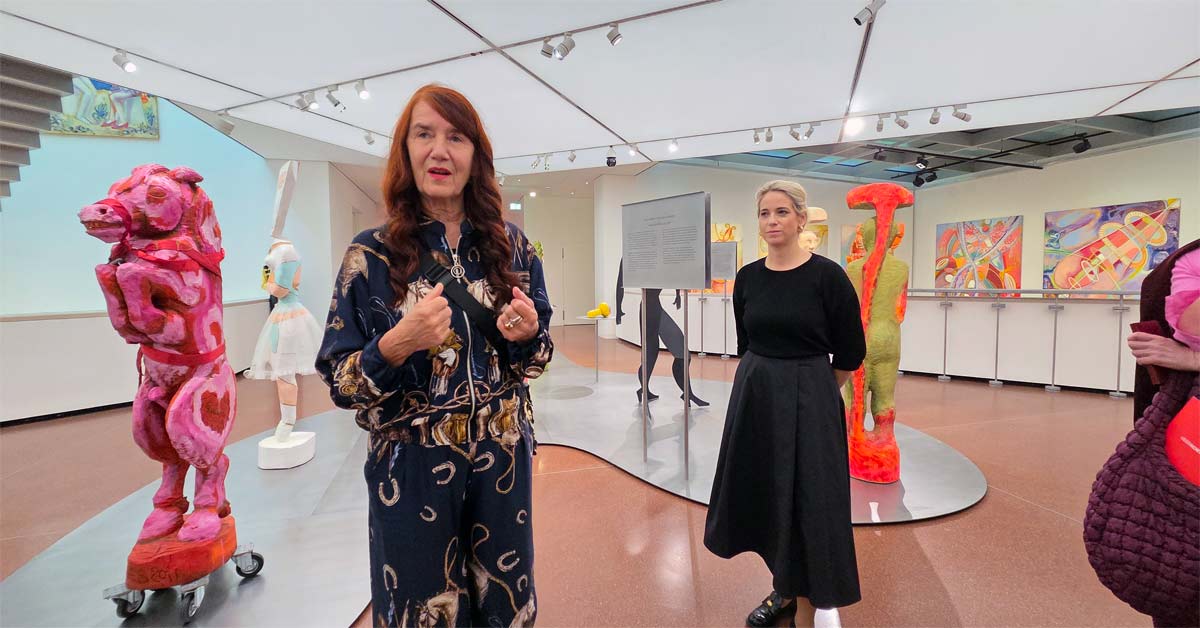
Quick Read
• The Heidi Horten Collection opens a major retrospective of Elisabeth von Samsonow on 19 September 2026. A retrospective with a wider field of viewAt today's press preview, Elisabeth von Samsonow's exhibition at the Heidi Horten Collection presented itself less as a conventional survey than as a network of connections between art, philosophy, the body and the Earth. The exhibition, opening to the public on 19 September and running until 28 February 2027, is the first major retrospective in director Verena Kaspar-Eisert's programme. It brings together works from almost five decades, including many being shown for the first time.The artist and philosopher studied art and philosophy and holds a doctorate in philosophy. Her intellectual background remains visible in the way her works move between sculpture, painting, performance, photography, writing and questions about how humans understand their position in the world. The press tour was led by Kaspar-Eisert, curators Hana O. O. Haas and Rolf H. Johannsen, together with Samsonow herself. Their alternating perspectives moved between the structure of the exhibition and individual works. The tour begins with earlier works from the 1970s before moving towards the large wooden sculptures that became central to Samsonow's practice from 1990 onwards. Mostly carved from whole limewood trunks, they retain a visible connection to the living material from which they originated. Some are equipped with wheels, strings or lights and can be activated through movement, sound or performance. The sculpture therefore becomes less an isolated object than a body with the potential to move, resonate and interact. From the body to Gaia and the GöttinnenlandA central thread of the exhibition is the idea of the Earth as a living, interconnected system. Here the ancient figure of Gaia becomes useful as a reference: in Greek mythology, Gaia is the personification of the Earth and a primordial female deity. Samsonow's use of the Earth/Gaia idea is not simply a return to ancient mythology. It becomes a way of questioning the relationship between humans, other forms of life and the ground on which society depends.This leads directly to the Göttinnenland in the Pulkau Valley in Lower Austria. Samsonow initiated the collective purchase of four hectares of land in 2020 in response to an intensively cultivated landscape and increasingly depleted soils. The land has since become an artistic, ecological and collective project. The idea is particularly clear in Why Women Must Own Land. Three photographs show Samsonow walking across the Göttinnenland wearing her grandmother's Sunday hat and her mother's wool skirt. The accompanying manifesto connects land ownership with feminist questions. It points to the fact that more than 95 percent of agricultural land in Lower Austria is owned by men and argues that questions of property and access to land cannot be separated from feminism. The placement next to Ferdinand Georg Waldmüller's Coming Home from Work from 1834 makes this more than a historical comparison. Waldmüller's rural scene shows a traditional division of labour, with the male worker returning home while women remain associated with domestic and caring roles. Samsonow's work shifts the question towards who has agency over territory and property – and what changes when women claim land not simply as a place to live, but as a means of shaping their environment. Samsonow meets the Horten CollectionTen works from the Heidi Horten Collection are integrated into the retrospective rather than being displayed as a separate collection section. They include works by Francis Bacon, Georg Baselitz, Alexander Calder, Francesco Clemente, Erich Heckel, Damien Hirst, Alexej von Jawlensky, Egon Schiele and Ferdinand Georg Waldmüller.The dialogue with Alexander Calder is particularly visible around Samsonow's sculptural figures. Her Transplants merge human and plant forms and point towards vegetal life and photosynthesis. Calder's Critter with Peaked Head, meanwhile, is a static painted-metal sculpture that nevertheless suggests movement. Another group of works draws on prehistoric forms. Samsonow's Girl figures refer to Cycladic idols, while her horses, geo-oracles and transplants form recurring bodies of work. The large Cycladic Idol (Large) and Rudiobus, Little Red Stallion are placed in a sculptural environment that also includes Calder's work. The exhibition therefore uses the collection as a kind of second voice. Familiar works are not simply displayed again; their formal or thematic relationships with Samsonow's works create new readings. Where couture enters – and where it does notThere was an interesting parallel to fashion around today's press event, although the Haute Couture Austria Award itself was not a subject of the press tour and has no presentation within the exhibition. Samsonow's work is the inspiration for the 2026 award, titled "THE LANGUAGE OF THE GODDESSES". The WKO lists the collection as inspired by Elisabeth von Samsonow and gives 19 January 2027 as the date for the award presentation at the Heidi Horten Collection.Previous editions have also connected couture with art or exhibition themes: the 2025 award The Black/White Line, was linked to the exhibition The Line, the 2024 edition to Yves Klein and blue, the 2023 20th anniversary collection Antibes to the French Riviera town beloved by Heidi Horten with custom textile creation by artist Peter Baldinger. The 2026 competition continues this practice, translating an artistic idea into made-to-measure clothing. That translation raises a question that is perhaps more interesting than the decorative idea of a "goddess" in fashion. Haute couture has historically been strongly associated with dressing women, but the question remains: who is defining the image of the woman, and for whom is the garment designed to be seen? Samsonow's work shifts attention from the external image towards agency, ownership, transformation and the relationship between body and environment. How these ideas will actually be translated into couture remains to be seen. The models will be submitted in October; the results of that process will enter the museum context when the Haute Couture Austria Award is presented there in January 2027. For now, Samsonow's exhibition leaves a broader proposition behind: the shaping of the Earth should not be treated as a domain reserved for men. In her work, land, bodies, plants, animals and cultural memory form a network in which the question of who acts – and who has the right to shape the future – becomes part of the artistic material itself. Image: Elisabeth von Samsonow during the 18 September 2026 press preview at the Heidi Horten Collection, with director Verena Kaspar-Eisert and sculptures including 'Cycladic Idol' and 'Rudiobus, Little Red Stallion', shown in dialogue with Alexander Calder. © Fashion.at |