
|
16 November 2026 What Does Fashion.at's Digital Twin Say About Its Readers?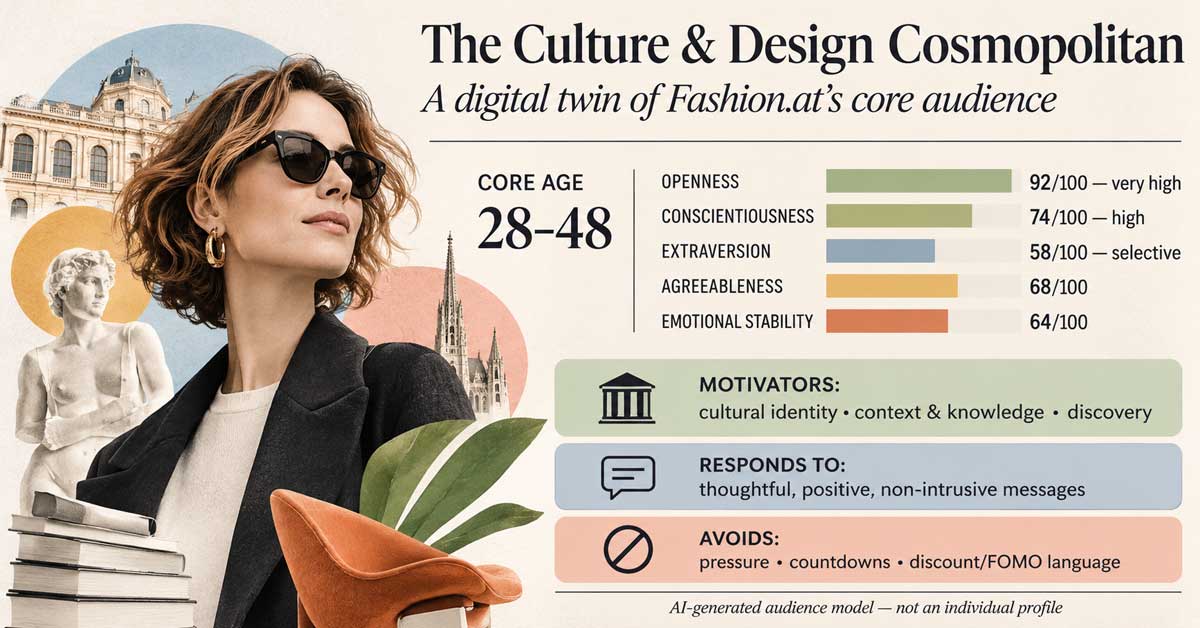
Quick Read
Fashion.at's test of an AI tool naturally began with a question: What might Fashion.at's digital twin look like? More precisely, who is the person most likely to read the magazine? The starting prompt was simple: "Create a digital twin for Fashion.at's most important user group." The response, generated through Google's Gemini, turned into a surprisingly detailed portrait of a fictional reader – and provided the basis for several experiments in editorial communication and subscription messaging.
• Fashion.at tested an AI-based Digital Twin tool developed by Dr. Josef Sawetz using Gemini 4 Argon. Meet the Culture & Design CosmopolitanThe AI-generated persona was given a name: Elena B., 36, a curator and cultural manager living in Vienna. The name is entirely fictional. She represents a model audience rather than an actual Fashion.at reader.The tool called this archetype "The Culture & Design Cosmopolitan", placing the core age group between 28 and 48. Its profile combines an academic or creative professional background with an interest in Austrian fashion design, contemporary art, cultural history, sustainability and intellectual lifestyle. The model was developed across several psychological dimensions. Using the Big Five personality framework, it assigned the fictional audience particularly high scores for openness to experience (92/100) and conscientiousness (74/100). Extraversion scored 58/100, agreeableness 68/100 and emotional stability 64/100. In practical terms, this describes someone curious about unfamiliar ideas, attentive to quality and interested in the background of things. The model's motivational profile adds three dimensions: cultural identity and self-expression, the desire for knowledge and context, and inspiration through discovery. This is not simply a reader who wants to know what is fashionable next season. She is interested in why a design matters, how craftsmanship relates to cultural history and what fashion can reveal about society. Testing a fictional subscription campaignThe next challenge was to test a campaign for an annual Fashion.at subscription, offering access to all pages of the magazine. For the first simulation, Fashion.at added a fictional thank-you gift: a bag in a Fashion.at design.The digital twin evaluated the campaign positively. Particularly interesting was its response to the bag. Rather than interpreting it as a conventional promotional incentive, the model regarded it as an appropriate expression of the magazine's cultural and design identity. The imagined gift was considered compatible with the interests of the core audience. The next test removed the bag entirely. Fashion.at also asked the tool to extend its analysis beyond the domestic readership to include the magazine's international audience. From Vienna to an international readershipThe expanded analysis identified the United States as an important strategic international market, Germany as the strongest European neighbouring market, and India and East Asia, particularly China, as relevant volume markets.The tool proposed different approaches to the annual subscription campaign. For Vienna and the DACH region, it suggested emphasising cultural events, exhibitions, design analysis and the magazine's archive dating back to 1996. For the international and US-oriented English-language edition, the focus shifted towards independent Viennese and European design journalism, cultural history and curated perspectives on art. The proposed message positioned the subscription as a way to support independent cultural journalism while gaining access to a year of editorial content. A two-month benefit with annual billing was also suggested. One common recommendation remained: avoid aggressive discount language, artificial urgency and countdown messages. According to the model, these approaches would conflict with the motivations of the intended audience. What the digital twin reflects – and what it cannot proveThe experiment is based on a combination of Fashion.at's existing audience statistics, its editorial structure and psychological research. The tool draws on the work of Sandra Matz and colleagues (2017) on psychological targeting, as well as a 2022 meta-analysis by Joyal-Desmarais and colleagues examining motivational message matching.The results are interesting, but their interpretation requires some care. The personality scores and reactions are generated model outputs, not measurements of individual readers. Similarly, predicted improvements in clicks or conversions are simulations, not results from an actual Fashion.at campaign. Nevertheless, the exercise confirms something important about the magazine's editorial approach. Fashion.at's readers are addressed as culturally curious people, not merely as consumers waiting for the next trend. Fashion is presented as a cultural practice, connecting design with art, history, society and everyday life. There is no need for loud promises or pressure to buy. Instead, the editorial approach offers an open, positive view of the world, encouraging readers to discover unfamiliar perspectives and broaden their cultural horizons. Perhaps that is the most interesting result of this digital experiment: the fictional reader Elena B. describes, in a surprisingly recognisable way, what Fashion.at has been practising every day – cultural discovery through fashion, supported by well-researched texts and an unobtrusive editorial voice. The annual subscription to Fashion.at is real. The Fashion.at-designed bag used in the first campaign simulation, however, exists only in the fictional scenario. |