
|
17 November 2026 Fashion Leads Austria’s Black Week Shopping List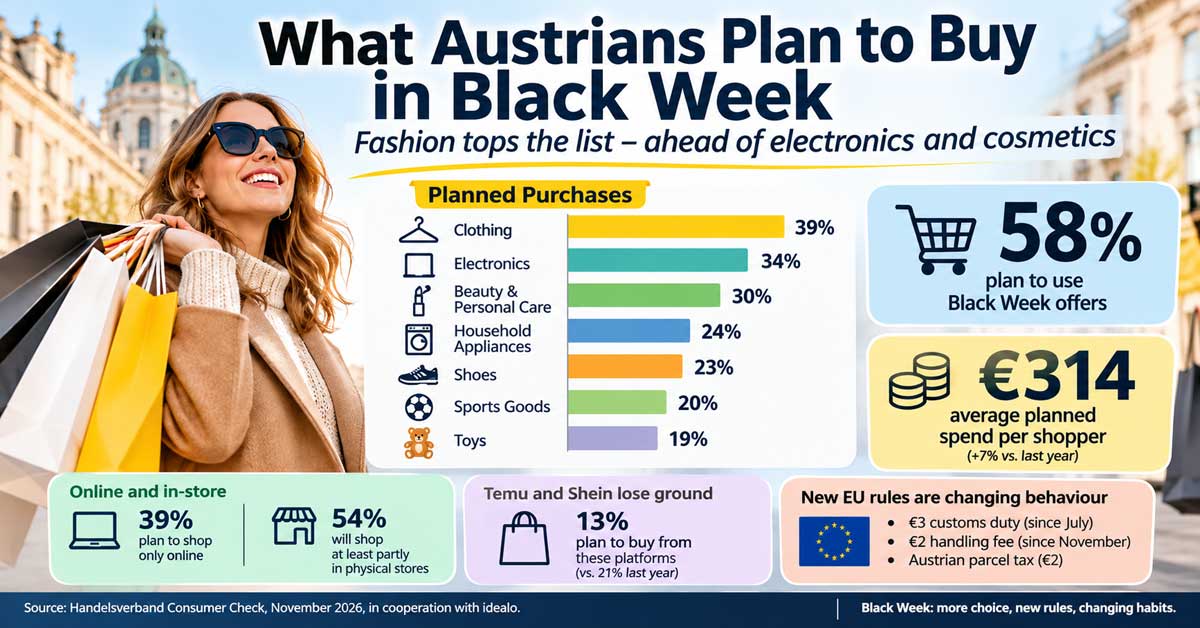
Quick Read
European online shopping is entering a new regulatory phase. Since July 2026, a €3 customs duty has applied to qualifying low-value imports from outside the EU. A further €2 EU handling fee followed in November. Austria also introduced a national parcel tax in October. These measures are changing the cost conditions for cross-border e-commerce, particularly for platforms such as Temu and Shein. Early figures point to fewer low-value imports and a shift towards European suppliers.
The latest Consumer Check by the Austrian Retail Association (Handelsverband), conducted in cooperation with idealo.at, now provides another perspective: fashion is the most frequently planned purchase category for Black Week in Austria.
• Fashion is the leading planned purchase category for Black Week in Austria, ahead of electronics and cosmetics.
Fashion ahead of electronics and cosmeticsAccording to the survey, 58% of the Austrian population intend to use Black Week offers around Black Friday on 27 November and Cyber Monday on 30 November. The Handelsverband expects total spending of approximately €460 million. Planned expenditure averages €314 per shopper, almost 7% more than last year. Clothing tops the shopping list, with 39% of respondents planning purchases in this category. Electronics follow at 34%, and perfume, personal care and cosmetics at 30%. Household appliances account for 24%, shoes for 23%, sports equipment for 20% and toys for 19%. Compared with the previous year, sports equipment gained six percentage points and toys four. Cosmetics and household appliances also became more popular.Temu and Shein lose ground as costs changeThe new European import rules are already affecting purchasing intentions. The temporary €3 customs duty, introduced on 1 July for qualifying goods imported in consignments worth up to €150, and the €2 EU handling fee introduced on 1 November have changed the cost structure of low-value imports. An earlier Handelsverband survey found that 49% of Austrians who had bought from Far Eastern platforms in the previous twelve months were ordering less after the introduction of the customs duty. The Austrian Post also reported a 30% decline in parcels from the Far East in the third quarter of 2026. The latest Consumer Check indicates a corresponding shift in planned online purchases. Austrian webshops and shopping platforms are named by 44% of online shoppers intending to buy during Black Week, up from 40% last year. German and other European providers account for 39%. By contrast, the intended use of Far Eastern platforms such as Temu and Shein has fallen from 21% to 13%.Online and physical shopping increasingly overlapThe survey also challenges the idea that Black Friday is primarily an online shopping event. While 39% of prospective Black Week shoppers plan to buy exclusively online, 43% intend to combine online and physical shopping. Another 11% plan to shop exclusively in stores. This means that 54% intend to make at least some purchases in physical shops, compared with 49% in the previous year.Shopping depends on availability, not just preferenceThe findings suggest that consumers increasingly move between digital and physical retail rather than choosing one channel exclusively. Online platforms offer convenient price comparisons and access to a broad range of products. Physical shops provide immediate availability, personal advice and the opportunity to examine goods before buying. However, the distinction is not always a matter of personal preference. Some products are available only online, others only through selected retailers or in particular locations. The decision about where to shop can therefore be determined by what is actually available, rather than by a free choice between two equally accessible channels.How the survey was conducted The Handelsverband Consumer Check, entitled *So kauft Österreich*, was conducted by Reppublika Research & Analytics on behalf of the Austrian Retail Association. A total of 1,007 people aged 18 and over in Austria were interviewed online (CAWI) between 15 October and 2 November 2026. The sample is described as representative of the Austrian adult population. The separate idealo survey, conducted by Kantar, involved 2,071 online shoppers aged 16 to 64 between 5 and 19 October 2026. The idealo shopping data refer to clicks on idealo.at during Black Week and Christmas week 2025, compared with an average October week. |