
|
2 October 2026 Fashion Meets Female History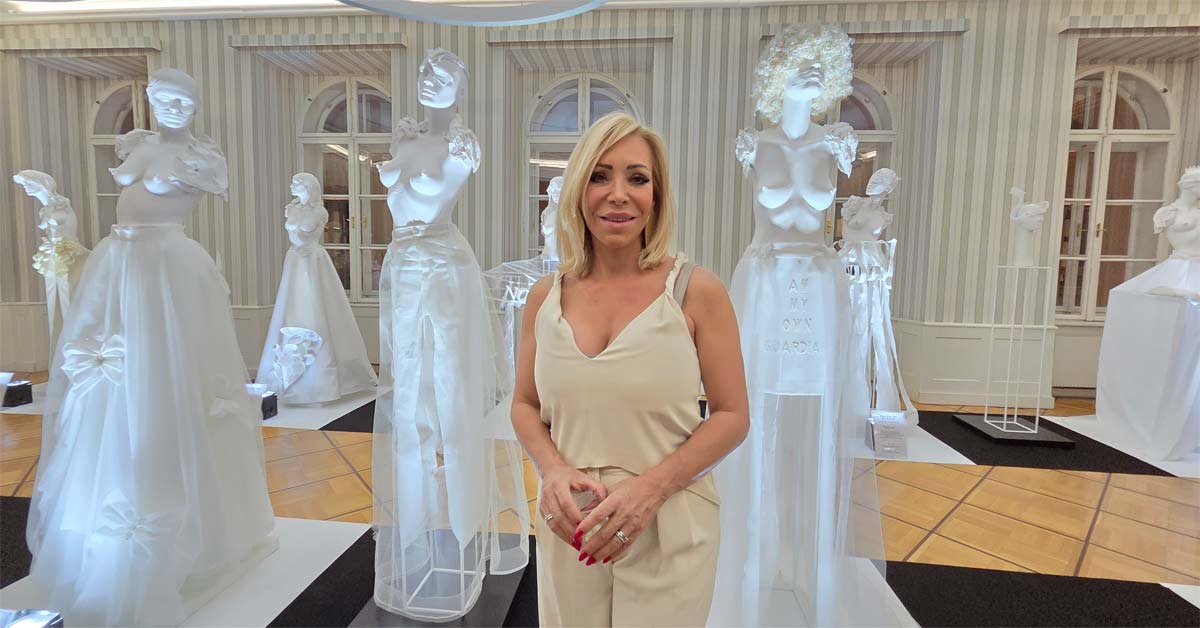
Quick Read
Fashion.at was invited to the opening of FE-DOM by Sabine Wiedenhofer, held on 1 October 2026 at MODE WIEN's premises in Vienna's Fütterergasse. The opening coincided with the first day of MODE WIEN EN SUITE, a recurring format in which members present and sell their work. The current edition runs until 3 October.
• Fashion.at visited the FE-DOM opening by Austrian artist Sabine Wiedenhofer at MODE WIEN in Vienna.
A MODE WIEN format meets contemporary artMODE WIEN is the public-facing platform of the Landesinnung Wien der Mode und Bekleidungstechnik, the professional organisation representing businesses in Vienna's clothing and related textile trades. Its tasks include representing members' interests as well as providing information, advice and support. Events are one way of bringing the work of its members into a wider public context.EN SUITE is structured around this idea: a temporary presentation and sales format bringing together locally produced fashion, accessories, jewellery, craft and selected art-related products. MODE WIEN has used the Fütterergasse venue at regular intervals for such presentations, while also combining fashion with exhibitions, talks and other cultural formats. The current collaboration puts that connection into a particularly visible form. Sixteen mannequins stand in the exhibition space, their exaggeratedly feminine bodies contrasted with the more androgynous appearance of many contemporary fashion mannequins. In her opening remarks, Wiedenhofer pointed to this change in the way the female body is represented in fashion. SKIRTOLOGY: the skirt as sculptureThe skirts are the result of a collaboration between Wiedenhofer and members of the MODE WIEN network. Under the title SKIRTOLOGY, the project treats the couture skirt not simply as clothing, but as a stage for construction, proportion, material and craftsmanship.The decision to work exclusively in white is equally deliberate. According to the exhibition concept, white represents purity, precision and timeless elegance. More practically, the monochrome surface removes much of the distraction that colour can create. The eye is directed towards the shape of each skirt, its construction and the differences between the individual makers' approaches. This makes the mannequins less like conventional shop displays and more like three-dimensional figures. The fashion object becomes part of the sculpture, while the sculpture provides a context for looking at the garment. A history of women told through garmentsThe most unusual element of FE-DOM is the series of names attached to the figures. Each sculpture is accompanied by an exhibition panel identifying a woman whose work or activism is connected with questions of rights, freedom or social change.Fredrika Bremer, described in the exhibition as a pioneer of the Swedish women's movement, is represented under the title FEMALE POWER, with a skirt by Alexandra Gogolok-Nagl. Bremer's 1856 novel Hertha addressed the legal status of unmarried women and contributed to a debate that led to changes in Swedish law. FREEDOM OF JUSTICE refers to German women's-rights activist Lida Gustava Heymann, whose skirt was created by Linda Zlok. Heymann was a central figure in the radical wing of the German women's movement and worked for women's suffrage. Other pairings shift the geographical and historical frame. NEVER GIVE UP refers to Nazanin Boniadi and the women of Iran's "Woman, Life, Freedom" movement, with a skirt by Doris Bittermann. FREEDOM OF SPEECH recalls French feminist and suffrage activist Hubertine Auclert, represented by a design from Jutta Maria Gürth. Auclert famously linked taxation to political representation and organised a tax protest by women denied the vote. From suffrage history to a planned larger installationThe selection continues with WINGS OF LIFE, dedicated to Olympe de Gouges and designed by Julia Lara König, and REBELLION, dedicated to American suffrage campaigner Susan B. Anthony and realised by Epic Couture. The accompanying panels turn the installation into something resembling a three-dimensional "who is who" of women who challenged established structures.Wiedenhofer also announced that FE-DOM is intended to continue beyond the current presentation. The 16 figures are planned to grow to 32, displayed alternately on white and black square platforms in a deliberate chessboard-like arrangement. The reference is visual rather than competitive: the figures are not placed in opposition, and a chessboard itself has 64 squares. A museum exhibition is being considered for next year, although details are not yet fixed. For now, FE-DOM remains at MODE WIEN as a meeting point between an established fashion-industry member format and an art project that uses clothing to make questions of representation, memory and female agency visible. |