
23 April 2026 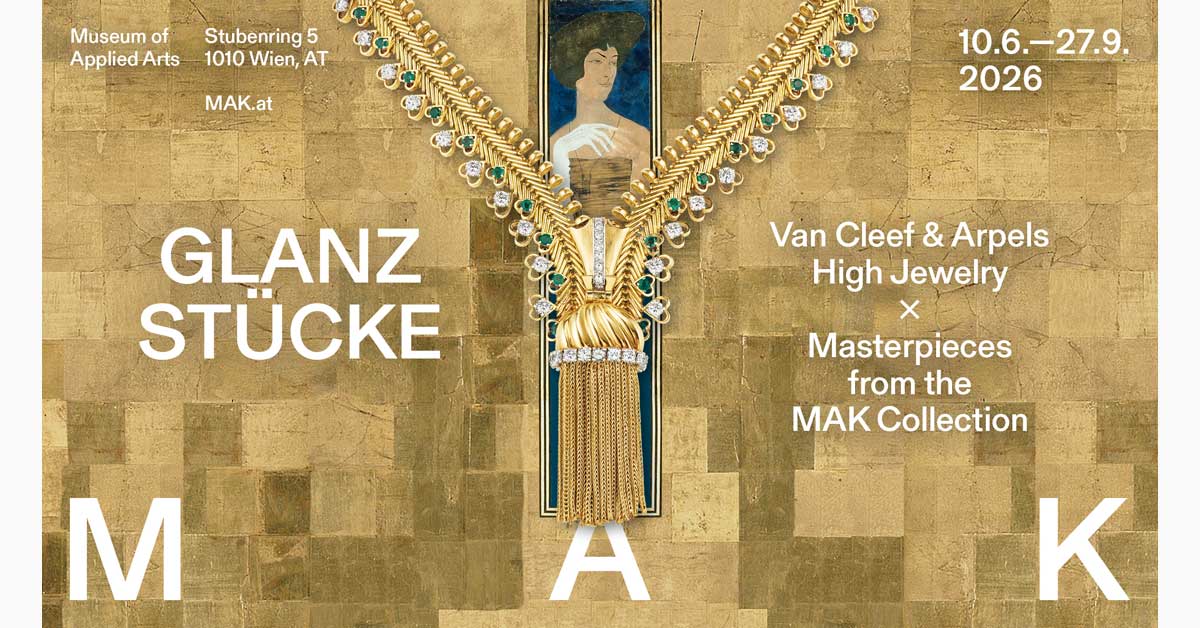 A Dialogue Between CollectionsFrom 10 June to 27 September 2026, the MAK – Museum of Applied Arts in Vienna presents 'Glanzstücke': Van Cleef & Arpels High Jewelry × Masterpieces from the MAK Collection. Around 500 objects—about 300 from Van Cleef & Arpels and 200 from the MAK—are arranged in six thematic chapters: Wanderlust, Architecture, Rhythmic Design, On Stage, Metamorphosis, and Nature & Cosmos.Founded in 1906 at Place Vendôme in Paris, Van Cleef & Arpels has developed a distinct language of high jewelry over more than 120 years. The MAK, established in 1863 and among the world's leading design museums, contributes works ranging from medieval textiles to Wiener Werkstätte design. The exhibition places these objects in direct dialogue, highlighting shared concerns such as craftsmanship, innovation, and visual storytelling. Wanderlust as the Starting PointThe exhibition 'Glanzstücke' opens with the theme of Wanderlust. Travel, movement, and distant cultures shape the first encounters in the scenographic parcours. A scale model of the sailing yacht Varuna (1906), crafted from gold, silver, and jasper, reflects early 20th-century fascination with exploration and technical refinement. It is placed in dialogue with a 17th-century "Portuguese Carpet" from Central Asia, depicting ships, sea creatures, and cross-cultural exchange. This pairing introduces the exhibition's guiding idea: objects from different regions and periods reveal shared visual narratives.A Labyrinth Through Time and SpaceThe scenography, conceived as a labyrinth, guides visitors through a journey across time and space. After Wanderlust, the section on Architecture focuses on structure and function, pairing the Minaudière (1933)—a compact case with refined compartments—with an 18th-century mechanical game table by David Roentgen.Rhythmic Design explores geometry and repetition, juxtaposing Art Deco jewelry such as the Silhouette Flower clips with textile patterns from the Wiener Werkstätte archive. On Stage turns to Vienna's cultural life, from a 19th-century ball gown to figurative jewelry pieces like fairy clips, reflecting themes of performance, dance, and music. Metamorphosis and Nature & CosmosIn Metamorphosis, transformability becomes central. The Zip necklace (patented in 1938, first produced in the 1950s), inspired by zippers in aviation and fashion, can be worn as a necklace or bracelet. It is shown alongside a folding screen by Koloman Moser (1906), whose gold-leaf surface reflects the transformation of Japanese influences within Viennese Modernism. Both objects also form the visual basis of the exhibition poster.The final chapter, Nature & Cosmos, focuses on organic and universal motifs. A key example is the Chrysanthemum clip (1937), demonstrating the "Mystery Set" technique, patented in 1933. This method allows gemstones to be set without visible prongs, creating a continuous surface of color and light. The piece is paired with a 1553 armillary sphere from the MAK collection, whose rotating rings visualize celestial movements and combine scientific function with artistic design. A Summer Highlight in ViennaBy linking jewelry with applied art across centuries and geographical regions, 'Glanzstücke' offers a structured exploration of design. The exhibition stands out as one of the notable museum presentations in Vienna in summer 2026.Image: Poster of the exhibition 'Glanzstücke' featuring the Zip necklace (1955) layered over a folding screen by Koloman Moser (1906). Graphic design by Bueronardin. © Van Cleef & Arpels Collection; © MAK/Georg Mayer Details: Zip necklace, 1955 Convertible into a bracelet; Yellow gold, platinum, emeralds, diamonds. © Van Cleef & Arpels Collection Koloman Moser, folding screen, 1906. Execution: Wiener Werkstätte/Karl Beitel/Therese Trethan. Wood, gold and marbled paper, decorative edging MAK, WWPA 830. © MAK/Georg Mayer |