
|
19 October 2026 Herend at Lobmeyr: 200 Years of Porcelain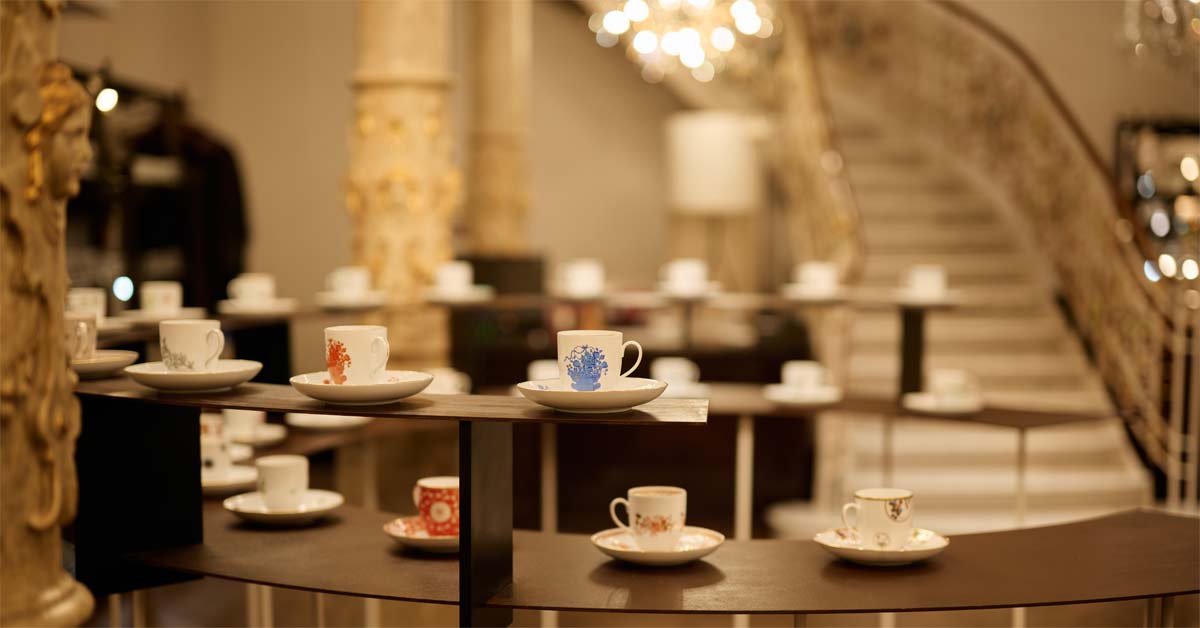
Quick Read
• Vienna-based Lobmeyr marks the 200th anniversary of Hungarian porcelain manufacturer Herend with an exhibition on Kärntner Straße.
Lobmeyr: Viennese craftsmanship with international reachFounded in Vienna in 1823, J. & L. Lobmeyr is known for glassware, chandeliers and lighting design. The family business became a supplier to the Habsburg court and built an international reputation for combining traditional craftsmanship with carefully considered design. Its history includes collaborations with designers such as Josef Hoffmann and Adolf Loos. Today, Lobmeyr continues to work with glass as both a traditional material and a medium for contemporary design. Its international business connects Viennese craftsmanship with markets in Europe, the United States and Asia. The company's presentation of Herend porcelain reflects another aspect of its work: table culture. Glass and porcelain serve different functions, but together they shape the appearance of a table. Transparent glass, painted porcelain and the forms of cups, plates and serving vessels create contrasts in colour, texture and light.More than 80 years of Herend at LobmeyrThe relationship between the two companies dates back to 1940. That year, Harald C. Rath, representing the fifth generation of the Lobmeyr family, took over the general agency for Herend in Austria. Since then, the Hungarian porcelain has been presented at Lobmeyr for more than 80 years. Herend's international reputation developed much earlier. Founded in 1826 by Vince Stingl in the Hungarian village of Herend, the manufactory expanded under Mór Fischer, who took over in 1839. A turning point came at the Great Exhibition in London in 1851, where the porcelain attracted international attention. Queen Victoria ordered a service decorated with butterflies and flowers, a design that became known as the Victoria pattern. The historical connection between the two manufacturers also extends to their customers. Lobmeyr refers to the Austrian imperial family, the Esterházy family and the Hotel Sacher among those associated with both names. In 2026, the hotel's Green Bar was again equipped with Herend porcelain and Lobmeyr glassware.Forty patterns and 60 different formsThe exhibition, which opened at Lobmeyr on Kärntner Straße on 15 October 2026, focuses on the variety of Herend's forms and decorations. According to the company, its repertoire comprises more than 16,000 forms and over 4,000 patterns. Most of the objects in the anniversary presentation were made specifically for the exhibition.Four groups of objects illustrate different aspects of the manufactory's work. • One form, 40 patterns: A breakfast set of cups and plates, based on a design by the Viennese studio Polka, demonstrates how different decorations can transform the same shape. • One pattern, 60 forms: A group of 60 service pieces shows how a single decorative design can be applied to cups, plates, jugs, bowls and other vessels. The display highlights the range of forms available within Herend's production. • Geometric decoration on animal figures: Herend's characteristic scale painting adapts an old Chinese pattern to the curved bodies of porcelain animals. The technique requires the painters to adjust the geometric design to complex three-dimensional surfaces. • Asian-inspired masterworks: Chinoiserie, the European interpretation of Chinese decorative art, is another important part of Herend's repertoire. The exhibition presents pieces that demonstrate the manufactory's approach to these elaborate patterns. A historic craft in a contemporary settingThe current presentation is the third major Herend exhibition at Lobmeyr since 2000. The two previous exhibitions focused on the manufactory's 175th anniversary in 2001 and its Chinoiserie designs in 2012. The anniversary display was conceived by the Lobmeyr team, with exhibition architecture by Hubmann.Vass. Its arrangement offers two complementary ways to understand Herend's extensive repertoire: comparing different patterns on the same form and examining how one pattern can unite a wide range of objects. This approach places the emphasis not only on porcelain as a finished product, but also on the work behind it. The number of available forms and decorations points to a production tradition that relies on specialist knowledge, hand painting and the continued use of established techniques.The exhibition runs at Lobmeyr on Kärntner Straße in Vienna from 15 October until early November 2026. Selected pieces will then be included in Lobmeyr's Christmas exhibition, opening on mid-November. |