
|
6 October 2026 Julia Kaufmann Earns Excellence Medal at WorldSkills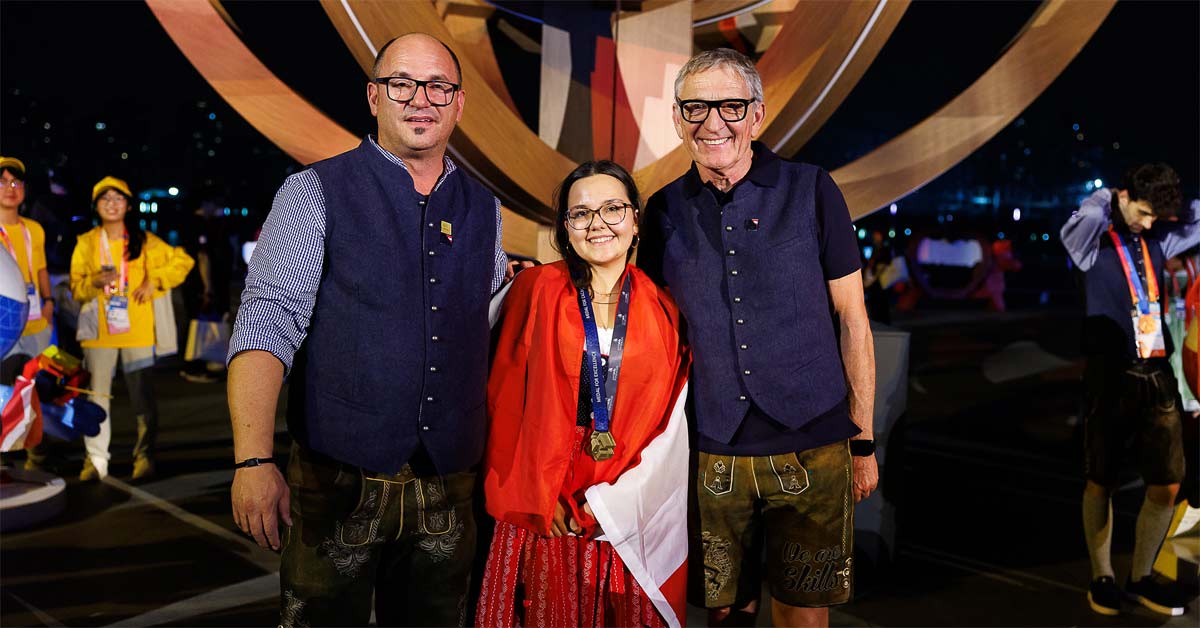
Quick Read
• Julia Kaufmann from Hart bei Graz received a Medal for Excellence in Fashion Technology at WorldSkills Shanghai 2026. When fashion becomes a skills competitionAt first glance, the SkillsAustria website looks surprisingly familiar. Its presentation of young competitors, national teams and international contests has something in common with a sports federation or even an Olympic team website. The comparison is not entirely accidental: AustrianSkills are described as national qualification competitions for EuroSkills and WorldSkills, while the international competitions bring together young professionals from many countries in individual skills and team events.One of the Austrian participants in Shanghai was Julia Kaufmann from Hart bei Graz. Kaufmann, born in 2008, attends Modeschule Graz, where practical fashion training runs alongside preparation for her school-leaving examination. Her WorldSkills profile describes her interest in turning an imagined garment into something she can actually make. At WorldSkills Shanghai, 31 competitors entered Fashion Technology. Kaufmann finished 15th with 701 points and received a Medal for Excellence, an award for competitors who reach the required standard of excellence even if they do not finish on the medal podium. China's Na Yu won gold, Brazil's Myllena Vitória de Arruda Nogueira silver, while Spain, Korea and France shared the bronze positions. ([WorldSkills 2026][1]) What does Fashion Technology actually mean?The name can be misleading. Fashion Technology at WorldSkills is not primarily about digital fashion, smart textiles or fashion software. It is a technically demanding garment-making discipline. WorldSkills describes the occupation as working with fabrics to cut and create clothes, from high-end fashion to high-street production. The work requires an understanding of fabrics and fashion, but also the ability to translate a design into a wearable garment. This can include sourcing and handling materials, developing patterns, cutting fabric and producing the finished piece.In Shanghai, the competitors had four days of practical work. The schedule ran from 23 to 26 September. Kaufmann had to develop designs, produce technical drawings and patterns, cut fabric and construct garments under strict time limits. Draping, accurate workmanship and the safe use of professional machinery were also assessed. Three garments had to be produced, alongside tasks involving sketching and draping. One central assignment involved developing an outfit for a customer celebrating her 30th birthday. The result is therefore closer to a four-day production challenge than to a conventional fashion show. A creative idea is only the starting point. It has to survive pattern construction, fabric handling, fitting, sewing and finishing – with very little room for error. Training like an athleteThat is where the sporting comparison becomes more useful. Kaufmann did not simply travel to Shanghai with her school knowledge. Her preparation included intensive training with Isabella Lindenbauer, a self-employed ladies' and menswear dressmaker who runs "Maßkleidung für Sie & Ihn" in Straßwalchen, Salzburg. Lindenbauer knows the competition from both sides. She was Austrian champion and vice-champion in Fashion Technology, won bronze at EuroSkills 2016 in Gothenburg and received a Medal for Excellence at WorldSkills 2017 in Abu Dhabi. She now trains Austrian competitors for EuroSkills and WorldSkills and works as an international expert. Under her supervision, Austrian Fashion Technology competitors have won gold at EuroSkills in 2021 and 2023 and silver in 2025, alongside several WorldSkills Medals for Excellence.The preparation is consequently about much more than practising individual sewing techniques. Every step has to be planned so that an initial idea becomes a technically correct, cleanly finished garment within a fixed time. It requires precision, concentration, speed and the ability to make decisions while working under pressure. The Federal Guild of Fashion and Clothing Technology in the Austrian Economic Chamber (WKO) supported Kaufmann's WorldSkills preparation both organisationally and financially. Its involvement also illustrates one reason why professional competitions matter beyond the medals: they make a technically demanding occupation more visible and provide a way of showing what advanced vocational training can involve. From JuniorSkills to AustrianSkills – and beyondThe competition ladder starts earlier for many young people. At the 2026 JuniorSkills competition for Fashion and Clothing Technology, held at the vocational school in Fürstenfeld on 26 September, Klara Kabst from Vienna took first place. Sophie Wenk from Tyrol was second and Barbara Ferner from Salzburg third. The participants had six hours to make a vest and a model sketch. But JuniorSkills are **not a compulsory first qualification for everyone** who later wants to compete internationally. AustrianSkills are the national championships and qualification competitions for EuroSkills and WorldSkills. The official rules allow participation by people in their final year of training as well as suitably qualified young professionals who have already completed their training. There is no minimum age for AustrianSkills, although the international competitions have their own age limits.The next AustrianSkills are scheduled for autumn 2027. Their winners are not automatically sent to an international competition: SkillsAustria also considers the subsequent preparation and the requirements for participation at EuroSkills or WorldSkills. For Fashion Technology, the next international stop is EuroSkills 2027 in Düsseldorf, from 22 to 26 September, where the discipline will again be represented as a team event. WorldSkills, by contrast, is the global competition; the 2026 edition in Shanghai brought together 1,400 competitors from 68 countries and regions across 64 skills after four days of competition. For anyone curious about the wider system, the WorldSkills website is essentially the international results and information hub. Competitions can be explored by skill and country, making it possible to follow individual occupations as well as national teams. In that sense, the sports analogy comes full circle: instead of watching athletes compete in running, swimming or gymnastics, WorldSkills lets visitors compare young professionals competing in occupations ranging from fashion technology to engineering, cooking and digital technologies. |