
|
7 September 2026 A New Line Around Glanzstoff’s Textile Factory Industrial Past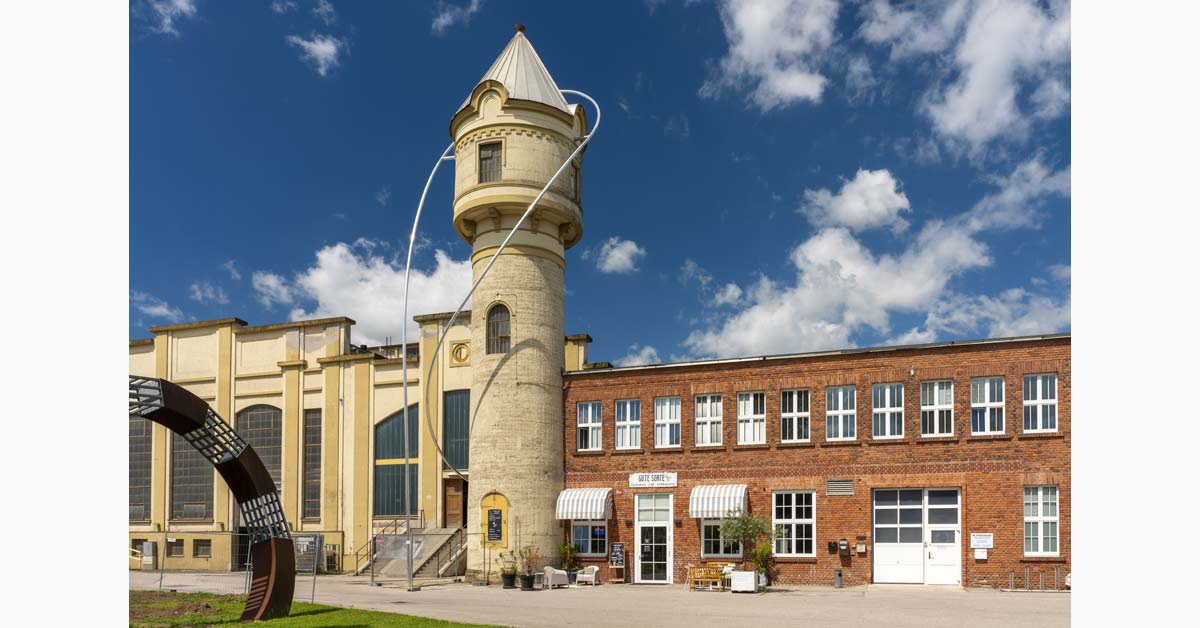
Quick Read
• A new landmark: Martin Walde's Luftlinie turns a former Glanzstoff water tower into a site for contemporary art.
From viscose factory to cultural siteFor more than a century, Glanzstoff was closely connected with St. Pölten's industrial identity. The factory began production in 1906 and became an important centre for viscose fibres. The development of the factory also helped shape the surrounding district and its working-class housing. After a major fire in 2008, production ended at the site. Much of the former factory has since disappeared, while selected buildings and structures remain as reminders of its industrial past.Today, the former industrial area is being gradually reused. The historic Konerei – the section where yarns were once wound onto cones for further processing – has become the venue dieKonerei for exhibitions, cultural projects and events. The change is therefore not simply from factory to museum: the site continues to be used, but for very different purposes. Two water towers, two artistic readingsThe former factory had two prominent water towers. Since 2017, one has been associated with Brigitte Kowanz's permanent light installation Fountain. The title is deliberately tied to the site: Kowanz referred to the water tower as a "source" and also connected the idea of a fountain with the notion of a think tank – a place from which new possibilities might emerge. The work was conceived as a sign of transition from the industrial past towards a possible future for the site.Walde's Luftlinie now creates a counterpart on the other side of the former factory complex. The metal line winds around the tower rather than simply decorating it. It is deliberately without a practical function. As art critic and author Sabine B. Vogel explains in the accompanying text to the announcement, the work shifts attention between line, tower and surrounding architecture. A bird circling the tower is one possible association; a line of thought tracing the building is another. A thread through the textile pastThe connection with Glanzstoff is more than visual. Walde's central motif is the line, and Luftlinie recalls the threads once produced on the site. This makes the location of the sculpture particularly apt: beside the former Konerei, where yarn was wound onto spools, the metal line can also be read as a deliberately oversized, three-dimensional thread.That interpretation should remain just that – an association rather than a literal description of the work. Walde's line is not a reconstruction of industrial machinery. It creates a new relationship between the historic structure and contemporary art. The title Luftlinie also points towards an imaginary direct line through space, while the work itself makes that supposedly simple line visible as something that moves, curves and changes with the viewer's position. Not about aviation – but perhaps about flightThe title Luftlinie—literally "as the crow flies" or "straight line"—may initially suggest an aviation reference. St. Pölten's Völtendorf sports airfield is only a few kilometres away, but the Glanzstoff site lies outside its regular approach and departure corridors. Völtendorf's grass runway runs 07/25, and its published procedures require a special traffic circuit for noise-abatement reasons. In other words, Walde's Luftlinie does not refer to aviation; its title points instead to an imagined line through space.Yet Vogel's reference to a bird offers a more poetic connection with the air. The line circling the tower could suggest movement through space – perhaps a bird, perhaps a thought, perhaps simply the viewer's eye. That openness fits Walde's wider practice. Born in Innsbruck in 1957, the artist studied at the Academy of Fine Arts Vienna and is known for experimental installations in which materials, movement, perception and transformation play important roles. Seen from the road, the tower and its new metal line have another quality: they make industrial history visible without freezing it in time. Together with Kowanz's Fountain, the intervention suggests a different way of preserving an industrial landmark – not by turning it into a static monument, but by continuing to add new meanings to it. On the former Glanzstoff grounds, the past remains physically present while the site keeps producing something new. Image: Martin Walde’s 'Luftlinie' wraps a former Glanzstoff water tower in St. Pölten with a large metal line. © Josef Bollwein |