
15 January 2026 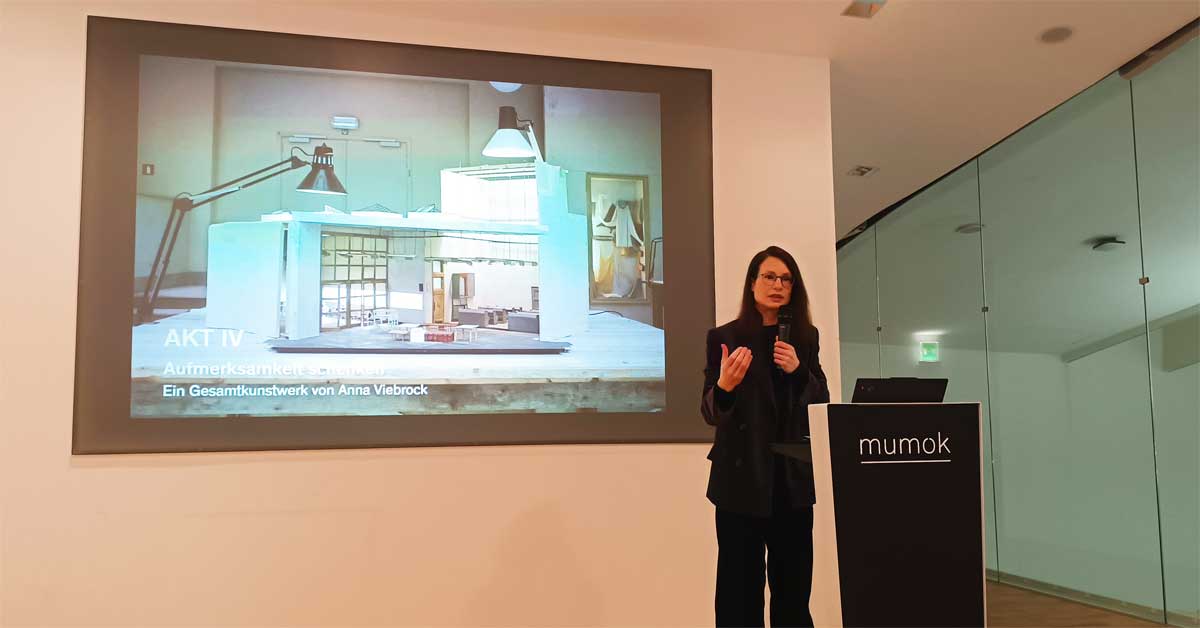 From today's press conference to a new directionToday's press conference at mumok in Vienna offered a clear first impression of where the museum is heading in 2026. In the lounge of the museum, the new director Fatima Hellberg presented the upcoming exhibition program and explained her curatorial approach. Since October 2025, Hellberg has been director of mumok – Museum moderner Kunst Stiftung Ludwig Wien. Before coming to Vienna, she led the Bonner Kunstverein in Germany and worked internationally as a curator in London, Stuttgart, and at institutions such as Tate Modern (details).Hellberg's focus is not on spectacle, but on perception. With a collection of around 13,000 works, she aims to make modern and contemporary art intellectually accessible without simplifying it. Her approach places the visitor in dialogue with the curated view: seeing is understood as an active act, not a neutral one. The collection becomes a "resonance space" in which past and present constantly interact. Terminal Piece: an exhibition like an operaThe program opens on 20 June 2026 (opening on 19 June) with Terminal Piece, a large group exhibition conceived in five acts. The title suggests both an ending and a threshold: a terminal as the end of a journey, but also the beginning of another. Each floor of the museum becomes a scene, similar to a large opera composed of different movements.A key role is played by stage and costume designer Anna Viebrock, known for her work with major opera houses and theaters such as the Vienna State Opera, Berlin's Volksbühne, and the Salzburg Festival, as well as for exhibition projects including the Fondazione Prada in Venice (details, video), bringing theatrical thinking into the museum. Visitors are not only looking at art, they are placed "on stage". The exhibition becomes immersive, and art is experienced as a situation rather than an object. The starting point is Terminal Piece (1972) by feminist artist and activist Kate Millett, the first work acquired under Hellberg's directorship. Millett's installation only exists through the presence of the viewer. It asks for attention to structures that have become invisible through habit – from everyday routines to political power systems. Listening and watching to what we usually do not hear and seeAcross the five acts, Terminal Piece explores different forms of encounter. One important aspect is sound and perception. Works by artists such as Verena Paravel and Nina Porter focus on realities that exist but usually escape human awareness. Paravel, for example, works with sounds from nature that are physically present but not consciously heard – like the noise made by ants. This idea of making the existing visible or audible again is central to Hellberg's curatorial thinking.Viebrock's scenography connects artworks from the collection with the museum's hidden infrastructures, such as storage and restoration. The visitor moves through spaces that reveal how art is kept, shown, and framed. The museum itself becomes part of the exhibition. Architecture, process, and participationHellberg extends this idea into architecture. In 2026, parts of the mumok building will be transformed. Walls and previously hidden windows will be opened to create more transparency between inside and outside. The redesign is led by architect Andrea Faraguna, who received the Golden Lion at the 2025 Architecture Biennale in Venice. The goal is to make the museum more open, welcoming, and easier to navigate.At the same time, Terminal Piece opens together with a solo exhibition by Tolia Astakhishvili. Her presentation focuses on artistic process. One floor functions as an open studio where visitors can observe and take part in the making of the exhibition. Participation here means time, presence, and shared attention. A museum for a time of uncertaintyBy the end of today's press conference, the mood was clear: fresh air, transparency, and a strong belief in art as a tool for understanding society. Mumok 2026 does not promise easy answers. Instead, it offers new perspectives on how we live together, how power works, and how perception can be trained.Without showing fashion, mumok may become one of Vienna's most "fashionable" places in 2026 – in the sense of being closely connected to the questions of our time. In a world shaped by fake news, complex political systems, and invisible dependencies, the desire for clarity and transparency is growing. Hellberg's program responds to this desire by making thinking through art physically and intellectually walkable. Image: Fatima Hellberg, General Director of mumok, speaks at the press conference in January 2026, presenting the exhibition 'Terminal Piece'. Behind her, a projected stage model by Anna Viebrock illustrates the exhibition’s scenographic approach. Photo: © Fashion.at |