
28 May 2026 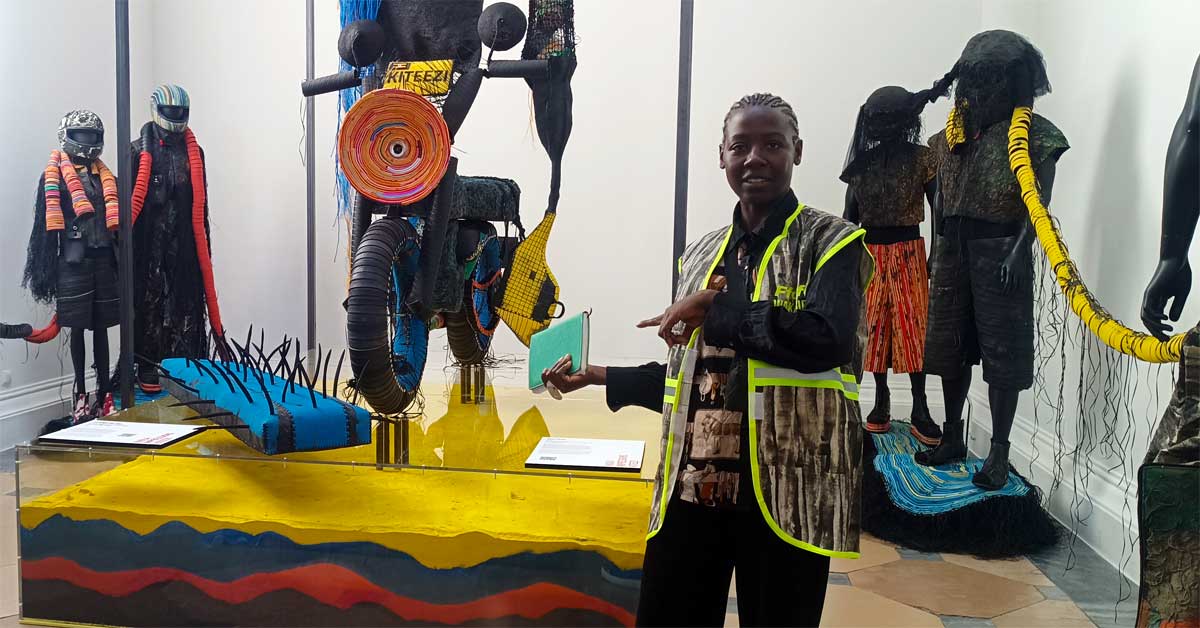
Quick Read
• Ugandan artist Nabukenya Allen, known as Njola, presented her installation and fashion collection "Kiteezi" today at the Theseus Temple in Vienna's Volksgarten.
Fashion, waste and the story of Kampala's Boda Boda driversAt today's press conference inside the neoclassical Theseus Temple in Vienna's Volksgarten, Ugandan multidisciplinary artist Nabukenya Allen — working under the name Njola and founder of Njola Impressions — introduced "Kiteezi", an installation combining fashion collection, sculpture and environmental commentary.The exhibition was developed in cooperation with the Weltmuseum Wien and centers on Kampala's Kiteezi landfill, where a deadly landslide in August 2024 exposed the consequences of decades of uncontrolled waste accumulation. The installation connects this local tragedy with global systems of overconsumption and waste export. At the center of the space stands a large reconstructed Boda Boda motorcycle — the motorcycle taxis that form a major part of Kampala's transport system. Around it are 13 outfits inspired by Boda Boda drivers and constructed from discarded materials including tires, plastic, textile waste and flip-flops. The transparent platform beneath the motorcycle contains layered colored granules produced from shredded flip-flops, symbolizing polluted soil layers. The exhibition creates a strong visual impression of movement, transit and circulation. Ropes connect sculptural elements across the room, suggesting global material flows between the Global North and Global South. Njola herself appeared at the press conference wearing a reflective vest with fluorescent yellow safety stripes similar to road service uniforms. Printed on the back was the phrase "Kiteezi Change. Culture Change" — a direct appeal to rethink global throwaway culture and consumption habits. From recycled tires to wearable paintingsNjola's practice moves between contemporary fashion and installation art. Materials that are normally considered waste become both narrative tools and visual surfaces. Thin threads cut from car and motorcycle tires form hair-like textures on figures and decorative details on garments. Ground flip-flops are transformed into pigments, mixed with binding agents and then applied onto textile surfaces and canvases.During the press conference, the artist also discussed a new artwork produced during her current two-month residency in Vienna. The work uses bicycle tubes collected from a bicycle repair shop in Vienna's 18th district. Small miniature motorcycles are attached across the flattened rubber surfaces. Njola noted that many of the tubes showed only minimal damage and could easily have been repaired instead of discarded. A making-of video documenting the process was recently shared on Instagram during her residency period. Fashion.at asked Njola about the blue rectangular objects covered with black spikes positioned in front of the motorcycle. Their appearance recalls police spike strips used to stop vehicles. The artist explained that the objects were originally discarded workout benches found at the Kiteezi landfill. According to Njola, they symbolize the difficulties of pushing ideas forward politically in Uganda. The thorns represent obstacles and resistance, but also endurance and persistence — the need to continue despite barriers. Claudia Banz and the new direction of the Weltmuseum WienBefore the press conference, Fashion.at briefly spoke with Claudia Banz, who became scientific director of the Weltmuseum Wien in February 2025.Banz previously led the Collection of Modern Art and Design at the Museum für Kunst und Gewerbe Hamburg between 2011 and 2017 and later worked as lead curator for design and outreach at Berlin's Kunstgewerbemuseum. It was during her Berlin period that she became familiar with Njola's work. Banz explained that she encountered the artist through research trips across several African countries focused on fashion and environmental topics. In 2019, she presented Njola's work in the exhibition "Connecting Afro Futures. Fashion x Hair x Design" at Berlin's Kunstgewerbemuseum. Asked how she sees the artist's development, Banz observed that Njola has moved beyond a primary focus on fashion objects toward more spatial and immersive installations. "Kiteezi" reflects this evolution by transforming clothing into part of a larger environmental and social narrative. Under Banz's leadership, the Weltmuseum Wien is increasingly positioning itself as a platform linking ethnology with contemporary ecological and social questions. Current projects such as "Regenerative Design" and "SUPERFLUX. The Craftocene", both running until 16 August 2026, examine circular economies, environmental futures and the relationship between design, technology and society. This strategy places collaboration with communities and interdisciplinary research at the center of the museum's work. Rather than presenting ethnographic collections as static historical objects, the museum increasingly explores how global systems, climate change and material economies shape everyday life today. Within this context, Njola's "Kiteezi" fits directly into the museum's future-oriented approach: combining contemporary art, environmental critique, participatory perspectives and questions of global accountability. Image: Ugandan artist Njola presents elements of her installation 'Kiteezi' during the press conference at the Theseus Temple in Vienna’s Volksgarten. The exhibition combines recycled materials, fashion and sculpture to address waste, mobility and global consumer culture. © Fashion.at |