
16 May 2026 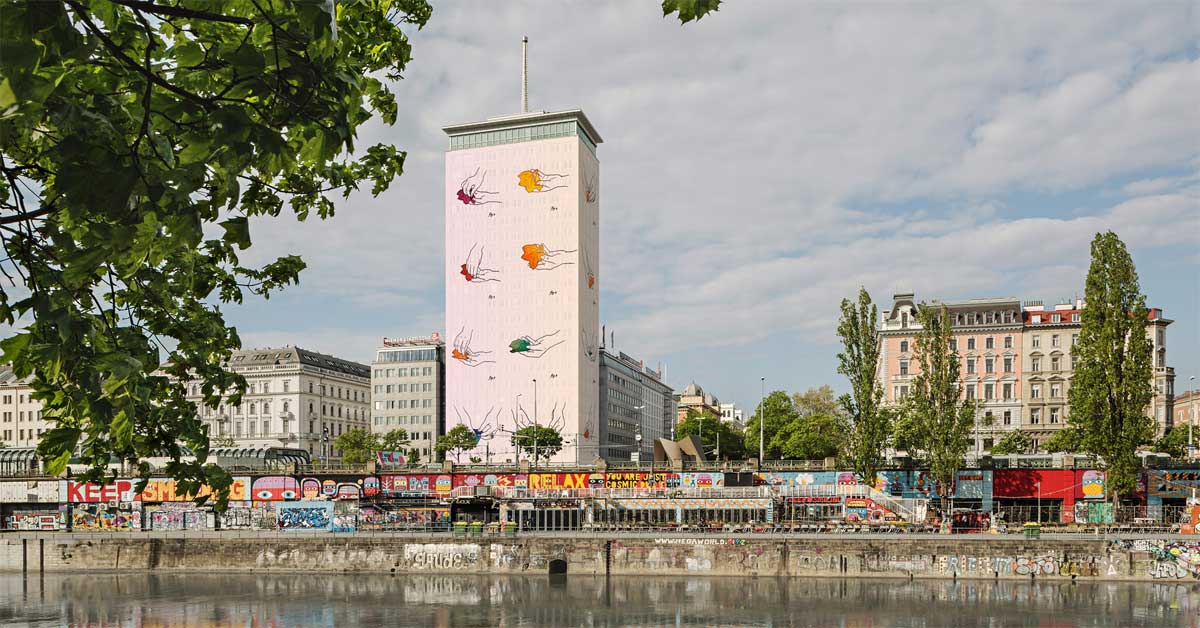
Quick Read
In Vienna, fashion observers have long looked at the annual Ringturm wrapping not only as a public art project but also as a material story. In recent years, the giant facade textiles have been transformed into limited-edition bags by the Viennese upcycling label gabarage. These objects have quietly become collector's items somewhere between design accessory, urban memory and contemporary craft. Whether the 2026 wrapping will again be turned into bags has not yet been officially announced. Still, previous editions suggest that many visitors will already be thinking ahead to the material's second life while the artwork is still hanging above the Danube Canal.
• Vienna's annual Ringturm wrapping returns with a large-scale artwork by Moldovan artist Pavel Brăila.
From Monumental Art to Everyday ObjectSince 2006, the Wiener Städtische Versicherungsverein has transformed the Ringturm tower into a seasonal public artwork. What began as an architectural art experiment gradually became one of Vienna's most visible summer installations. Since 2012, the programme increasingly invited artists from Central and Eastern Europe — regions where the Vienna Insurance Group is economically active. The selection of artists reflects a broad geographic and artistic spectrum. Austrian artists such as Xenia Hausner, Gottfried Helnwein and Johanna Kandl appeared alongside names from Hungary, Slovakia, Croatia, Serbia, Poland, Bulgaria and now Moldova. The projects differ visually, yet many share a similar approach: they place everyday life, social connection or emotional experience into large public space. Titles such as "A Sense of Family", "Summer Pleasures", "With each other", "Linking Tales" or "Future Dreaming" suggest a recurring interest in human relationships and collective optimism rather than confrontation or spectacle. Even when the works deal with political or social realities, they often use accessible visual language linked to ordinary life.A Recipe as a SymbolThe 2026 work carries the title "Your Happiness is in Your Own Hands". The phrase immediately sounds personal, almost like advice passed between generations. Pavel Brăila translates this idea into a sequence of illustrated hand movements showing the preparation of sarmale — stuffed vine leaves common across southeastern Europe. The choice of the dish is central to the project. Sarmale is not presented as luxury cuisine or folklore decoration. Instead, the preparation process becomes a visual language about migration, memory and belonging. For many people who live abroad, recipes survive longer than geography. Cooking becomes a portable connection to home.An Artist Between BordersPavel Brăila, born in Chișinău in 1971, represents Moldova at the 2026 Venice Biennale. His work often deals with borders, post-Soviet identities, movement and social transformation. International audiences first noticed him widely through his 2002 work "Shoes for Europe", shown at documenta11. Unlike purely decorative facade art, Brăila's projects usually connect physical actions with larger political and emotional questions. In the Ringturm installation, this continues through the act of cooking. The preparation of food becomes both domestic routine and cultural archive. The project also reflects Vienna's role as a meeting point between Western and Eastern Europe. Over two decades, the Ringturm wrappings developed into visual bridges between different cultural regions. The works appear temporarily, yet they often stay present in public memory through photographs, discussions and recycled design objects.Installation Continues Through Early SummerThe wrapping process has already started. Around 30 printed mesh panels — each up to 63 metres long — are currently being mounted onto the tower's facade. The complete installation is expected to be finished in the coming weeks and will remain visible during the summer months along the Danube Canal. As in previous years, the project turns the Ringturm into more than an office building. For a season, it becomes part landmark, part public gallery and part urban surface carrying stories about identity, memory and everyday life across Europe.Image: Rendering of the 2026 Ringturm wrapping in Vienna by Moldovan artist Pavel Brăila. The facade artwork 'Your Happiness is in Your Own Hands' shows stylised hand movements linked to the preparation of sarmale. © Hertha Hurnaus / Wiener Städtische Versicherungsverein |