
|
25 September 2026 Roman “Smartwatch”: A Sundial Made for Travel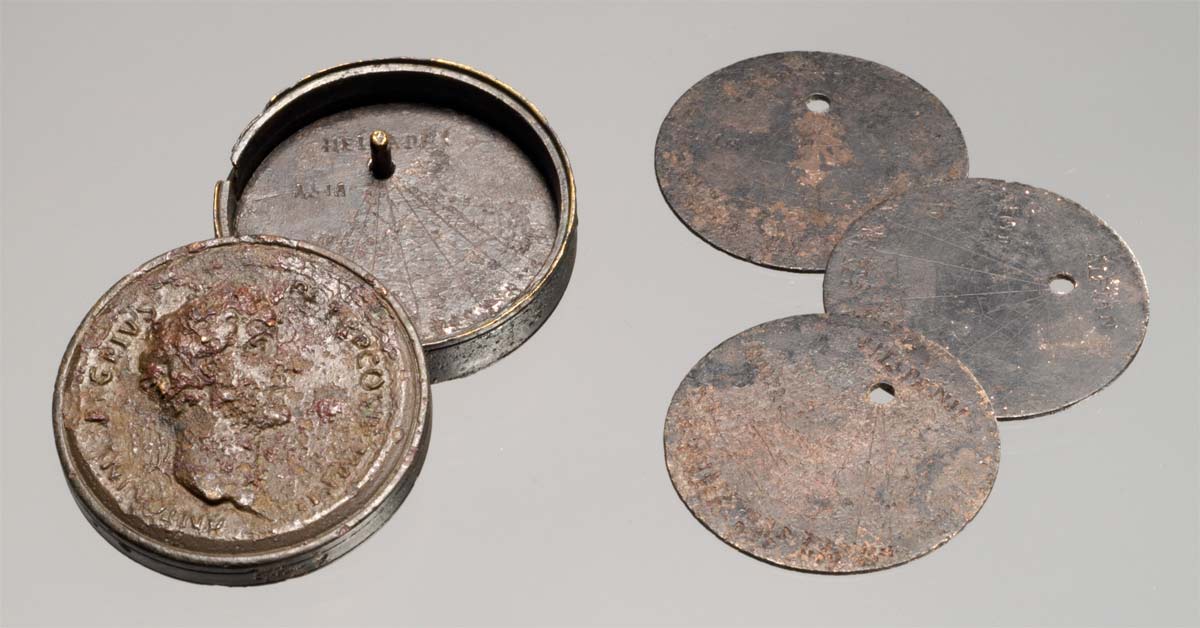
Quick Read
• The Kunsthistorisches Museum presents a rare Roman portable sundial from the 2nd century AD in Vitrine EXTRA #9. A small format with a changing focusThe new presentation is the ninth edition of Vitrine EXTRA, a format launched by the Kunsthistorisches Museum's Collection of Greek and Roman Antiquities in September 2022. Rather than creating a separate exhibition, the series places selected archaeological objects temporarily within the permanent collection. The aim is to bring less familiar objects, new research, restored pieces and unusual aspects of antiquity into the museum's regular display.The first Vitrine EXTRA focused on the newly restored Aphrodite of Ephesus. It was followed by a Greek cup and its restitution history in #2, the themes of nudity and sexuality in #3, provenance and the art trade in #4, ancient shipwrecks and cultural heritage in #5, research into ancient polychromy in #6, Greek vase inscriptions in #7 and ancient female portraits in #8. From 25 September 2026 to 14 March 2027, Vitrine EXTRA #9 is devoted to the Roman portable sundial under the title "Prime Time – Travelling with a Roman Portable Sundial". An ancient "smartwatch" — with a learning curveThe KHM has presented the object in its current publicity as a 1,800-year-old "smartwatch". The comparison is catchy, but the interesting point is not that the Roman instrument was an ancient version of a digital watch. It is that such a tiny device compressed a considerable amount of astronomical and geographical knowledge into a portable object.The sundial is made of cast bronze and measures about 4.1 cm in diameter. Its round lid carries a cast portrait of Antoninus Pius, who ruled from AD 138 to 161. On the inside, the lid contains a mathematical diagram, while the box holds a small pin and the four interchangeable discs. Each disc has two sides, with hour diagrams calculated for different latitudes. The discs are the clever part. Instead of carrying a separate sundial for every destination, the traveller could select the side corresponding to the latitude of the place where the instrument was being used. The surviving KHM object therefore reflects a Roman world in which travelling long distances also meant dealing with changing geographical coordinates. Research on this type of portable sundial shows that latitude was central to its design. How did the Roman traveller actually use it?The answer is more complicated than simply pointing the little instrument towards the Sun. First, the appropriate disc had to be placed uppermost according to the location. The date was then set by turning the small ruler to the corresponding month or season.Only then could the search for the time begin. Sunlight entered through a tiny opening in the side of the bronze case and produced a small spot of light on the ruler. The user had to rotate and position the instrument until the light behaved correctly and the spot fell on the appropriate hour line. The sundial also had to be held approximately perpendicular to the Earth's surface. There is no surviving holder, so exactly how Roman users stabilised the instrument remains uncertain. This also corrects a tempting modern simplification: there is no good basis for saying that the wearer simply had to point the device precisely south. The surviving evidence for this particular type describes its positioning through the incoming sunlight and the geometry of the instrument. What the user certainly needed was an understanding of place, season, the movement of the Sun and the instrument's orientation. And there was no magnetic compass to make this a push-button operation. A practical magnetic compass was not part of Roman technology. Orientation instead depended on astronomical observation and practical knowledge of the Sun's movement. The portable sundial itself was therefore a piece of technology that assumed a knowledgeable user. What happened when the Sun disappeared?There was an obvious limitation: a sundial cannot tell the time without sunlight. Clouds could interrupt the reading, and at night there was simply no solar beam to produce the required spot of light. Roman timekeeping therefore did not depend on sundials alone. Water clocks could measure time independently of direct sunlight and were used for purposes including night-time timekeeping.The hours themselves were also not quite the hours we know today. Roman daytime was divided into twelve seasonal hours between sunrise and sunset. Their actual length changed with the season: a daytime "hour" in winter was shorter than one in summer. The portable sundial was designed for this system rather than for our fixed 60-minute hour. That makes the tiny bronze object an unusually good way of imagining everyday life in the Roman Empire. The technology may look familiar in principle — a portable instrument for checking the time — but using it required knowledge that is now largely invisible to us. Vitrine EXTRA makes precisely this kind of connection possible. Instead of leaving an ancient object as something to look at, it asks what it meant to use it, what knowledge it demanded and what happened when its conditions were not met. In this case, the Roman traveller had no smartphone, no GPS and no magnetic compass — but could carry a sophisticated little instrument and know how to read the Sun. And if the latest technology happens to fail today, knowing a little about the old technology may still get you roughly to the right hour — provided, of course, that the Sun is cooperating. Image: Roman portable sundial, box, lid and four discs, bronze, Roman, after AD 142–144, Kunsthistorisches Museum, Collection of Greek and Roman Antiquities, Inv. VI 4098. © KHM-Museumsverband. |