
|
20 October 2026 To Shoe or Not to Shoe: What Shoes Say About Society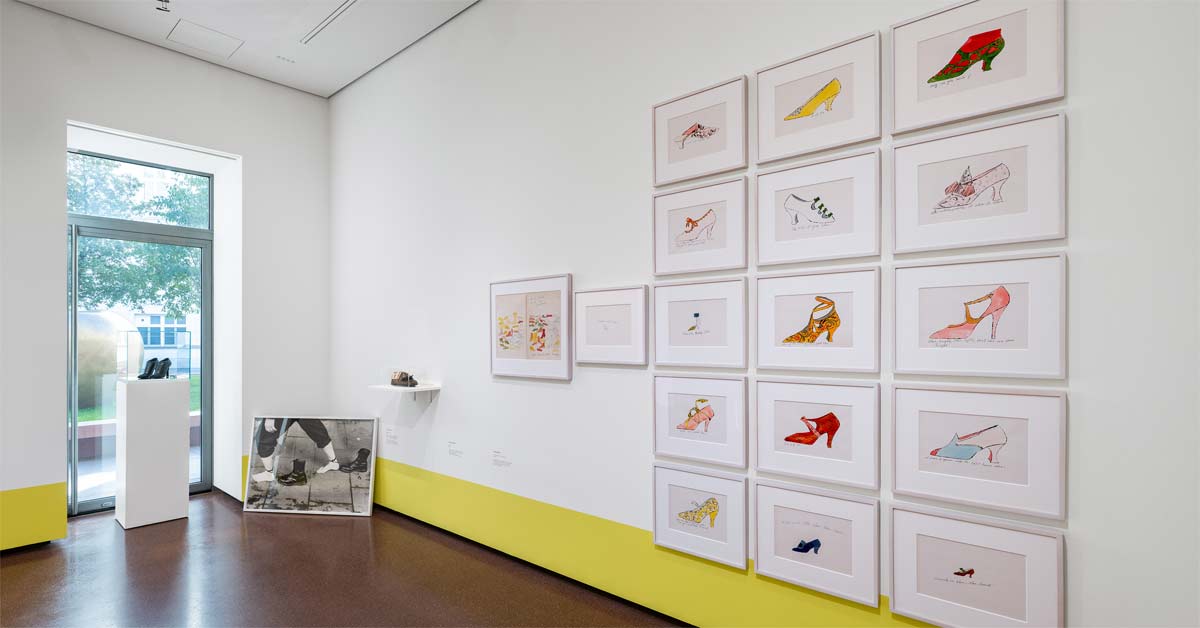
Quick Read
• Andy Warhol's shoe illustrations from the 1950s provide the starting point for an exhibition about fashion, desire and social identity.
From a Shoe Advertisement to an Art Historical QuestionThe title To Shoe or not to Shoe borrows the rhythm of Hamlet's famous question, "To be or not to be", from Shakespeare's tragedy. The exhibition replaces an existential dilemma with a familiar object that can carry surprisingly complex meanings. Shoes are practical necessities, fashion statements and markers of social position. They can suggest seduction, conformity, ambition or resistance.The starting point is Andy Warhol's À la recherche du shoe perdu, a series created around 1955, when he was working as an illustrator for the American shoe manufacturer I. Miller. Between 1955 and 1957, Warhol produced weekly shoe drawings for advertisements in The New York Times. The work paid his bills, but it also gave him a close view of how commercial images could shape desire. The portfolio was a separate artistic project, comprising 18 offset lithographs with added colour. Its title plays on Marcel Proust's À la recherche du temps perdu (In Search of Lost Time). Poet Ralph Pomeroy supplied witty captions, and the sheets were coloured by hand at gatherings with friends. Warhol's commercial illustration and his independent art thus shared a visual language without being the same undertaking. Fashion, Art and the Polished Museum SettingThe exhibition also reflects an approach associated with the Heidi Horten Collection: presenting art through visual connections that cross the boundaries between high culture, fashion and everyday life. The museum's bright, contemporary interiors provide a calm setting for works that are often immediately appealing to the eye but less comfortable in their implications.Shoes make a particularly effective subject for this approach. Their shapes, materials and colours invite close looking, while the ideas attached to them lead elsewhere: to gender expectations, class, consumer culture and the question of who gets to define how a body should look or behave. The exhibition brings together around 20 works from the collection and selected loans, curated by Rolf H. Johannsen. Sylvie Fleury and Mona Hatoum: Luxury Versus VulnerabilityTwo works make the range of these perspectives especially clear. In Sylvie Fleury's Alaïa Shoes (2003), a pair of ankle boots associated with the French luxury fashion house is cast in black-patinated bronze. The material changes the status of the object. Shoes designed to be worn become a sculpture to be looked at: no longer a functional accessory, but a durable, carefully finished object that invites contemplation.Fleury's work addresses the attraction of luxury goods and the way brands can acquire a value beyond their practical purpose. The bronze casting takes the logic of the fashion fetish a step further. The object is no longer simply desirable because it can be worn; its form itself becomes the focus of attention. The work leaves open a question familiar from consumer culture: where does appreciation of design end and fascination with status begin? Mona Hatoum's work offers a much harsher reading of footwear. In Roadworks (1985), the Palestinian-British artist walked barefoot through Brixton, London, dragging heavy black Dr. Martens boots tied to her ankles by their laces. The performance was documented on video. The boots carried associations with British police and, at the time, with skinhead groups linked to racist violence. Hatoum's exposed feet and obstructed movement made vulnerability visible against the threatening weight of the footwear. Placed alongside Fleury, Hatoum shifts the discussion from the attraction of the luxury object to the power that objects can represent. One work examines the seductive surface of consumer culture; the other evokes intimidation, social division and physical constraint. The shoe becomes a lens through which to view two very different relationships between individuals and the world around them. Between Protection, Restriction and Self-DeterminationOther artists complicate the familiar associations between shoes, femininity and vulnerability. Gudrun Kampl's Vorwärtsschnitt combines red velvet with blades at the tips of the shoes, turning an object associated with elegance into something potentially threatening. The work challenges the assumption that femininity must be synonymous with softness or powerlessness.Jakob Lena Knebl's Boot brings a high-heeled shoe and a work boot together. The combination places different gender codes and social associations in direct contact: glamour and physical labour, conventionally feminine styling and practical footwear. Birgit Jürgenssen, meanwhile, connects shoes to women's life stories and traditional roles, while other works in the exhibition address desire, discipline and the marks left by everyday experience. A walk through the exhibition therefore offers more than a sequence of attractive shoe designs. Its works form a kind of social kaleidoscope, reflecting different attitudes towards bodies, status, power and belonging. What appears at first to be a display about footwear becomes a view of the people, expectations and conflicts behind it. The question is not simply what shoes say about style, but what they reveal about the society in which they are worn. |