
18 April 2026 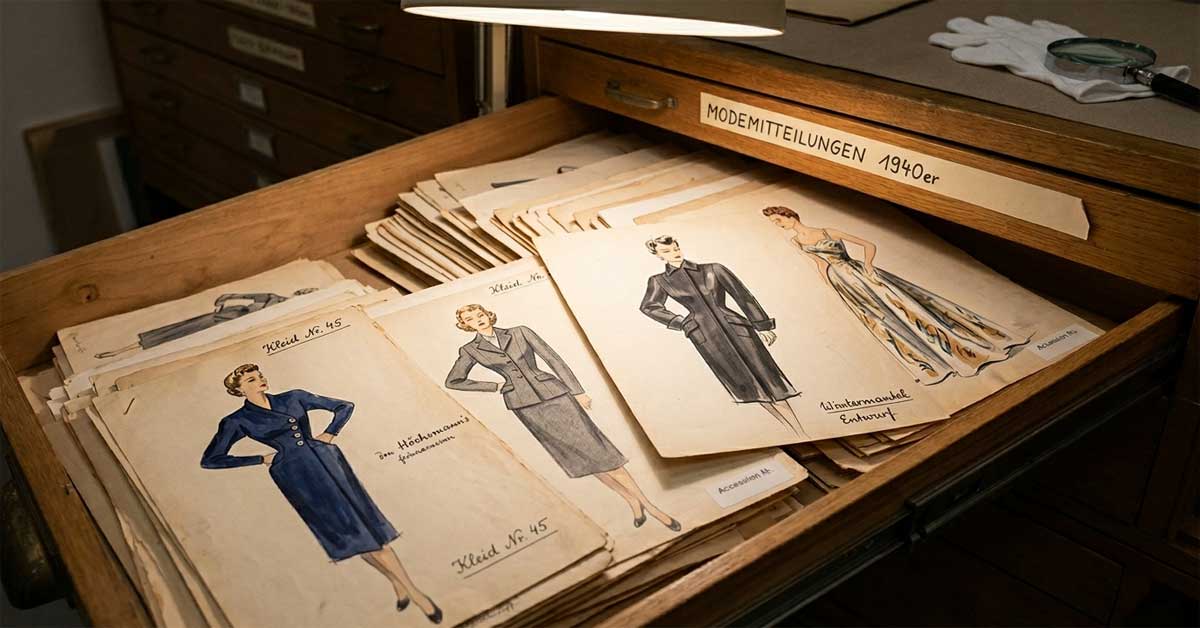 A recent conversation between Fashion.at publisher Karin Sawetz and Google's Gemini on 17 April 2026 began as a casual exchange. It quickly turned into something more revealing: a closer look at Vienna's fashion history—and a noticeable gap within it. Five Centuries of Style—and One SilenceVienna's fashion history spans around 500 years, moving from strict Spanish-influenced court dress to the elegance of the Habsburg era, the craftsmanship of the 19th century, and the experimental spirit of early modernism. Around 1900, figures like Emilie Flöge and the Wiener Werkstätte challenged conventions and shaped a new visual language. The interwar period turned Vienna into a vibrant fashion center. But this development was abruptly interrupted in 1938. The Nazi regime restructured the industry, replacing a diverse and largely Jewish fashion scene with a centralized institution: the so-called "House of Fashion."The "House of Fashion" and Its Limited VisibilityDuring the conversation, Sawetz identified a key issue. While the "House of Fashion" is acknowledged in research and exhibitions, it has rarely been the sole focus of one. Exhibitions such as "Vienna Falls in Line" at the Wien Museum addressed the topic (article), but only as part of a broader narrative about Nazi cultural policy. Similarly, projects connected to the Palais Lobkowitz—today home to the Theatermuseum—have examined the building's history, yet not through a single, dedicated exhibition on the institution itself. This absence is striking. The "House of Fashion" was not a minor episode. It stood at the center of a system built on dispossession, propaganda, and the destruction of Vienna's Jewish fashion industry.A Proposal for a Missing ExhibitionSawetz asked Gemini how such an exhibition could look. The response outlined a structure that begins not with design, but with documentation: files, names, and evidence of "Aryanization." Only then would garments appear—presented alongside their political context. Further sections would examine fashion as propaganda, the role of designers, and the continuity after 1945. Figures like Fred Adlmüller were mentioned, though not as the central focus, but as part of a broader system that allowed careers to continue with limited public scrutiny. A final section would address what remains unresolved: the silence, the gaps, and the difficulty of confronting uncomfortable histories.Fragments, Archives, and Ongoing QuestionsToday, parts of this history survive in archives and collections, including those of the University of Applied Arts Vienna. Even funding structures, such as the Adlmüller-related scholarships, appear as small footnotes in a larger narrative. The conversation between Sawetz and Gemini highlights an important point: artificial intelligence can summarize history, but it can also reproduce its gaps. Not every narrative is complete, and not every absence is immediately visible. In the case of Vienna's fashion history, further research remains necessary. Difficult histories rarely follow simple structures. They resist clear storytelling, and they challenge easy conclusions. And perhaps most importantly, they remind us that it is not always easy to "pigeonhole" people or events—to put them into neat categories or simple boxes, even if that would make things more comfortable.Annotation: After the initial overview and the following chat, Sawetz asked Gemini why the "House of Fashion" had not been included in a 500-year narrative of Vienna's fashion history. The answer pointed to a structural problem in how history is often told. Short summaries tend to focus on continuity—on styles, aesthetics, and visible achievements—while disruptive or uncomfortable periods are reduced or omitted. The years between 1938 and 1945 are often treated as an "unnatural interruption" rather than as an integral part of the story. Gemini explained that the "House of Fashion" is frequently misclassified as a technical or stylistic episode, because many of its designs continued earlier traditions of Viennese craftsmanship. What is overlooked is the context: the institution was built on the exclusion and dispossession of Jewish designers and functioned as part of a political system. This makes it harder to integrate into simplified narratives that prioritize artistic development over structural change. Another reason is the relatively late critical research into this period. Much of what is known today has only been systematically examined in recent decades. Earlier archives and widely circulated knowledge often downplayed or ignored these connections, and such gaps can persist in AI-generated summaries. Gemini concluded that the omission reflects a broader tendency to present fashion history as a sequence of styles rather than as a sequence of events shaped by power, ideology, and loss. Including the "House of Fashion" would shift the narrative from decorative history to a more complex and sometimes uncomfortable account of the city itself. Image: This AI-generated illustration depicts an open wooden drawer filled with vintage 1940s fashion sketches of women's clothing. © Fashion.at generated with Google AI |