
24 May 2026 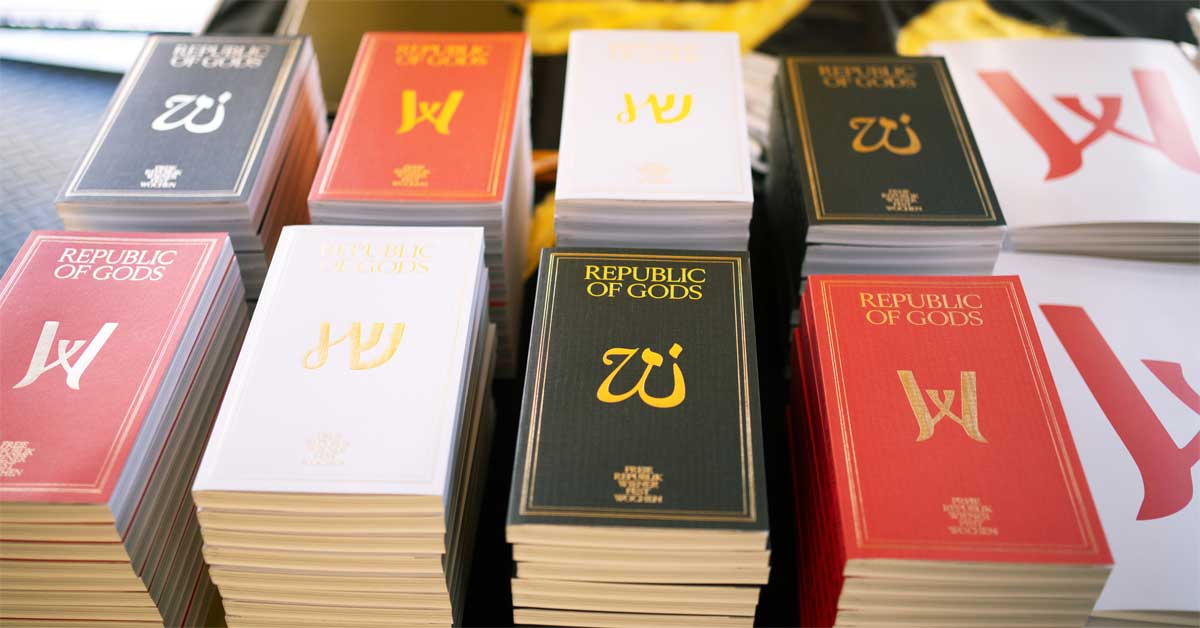
Quick Read
The Vienna Festival | Free Republic of Vienna is celebrating its 75th anniversary from 15 May until 21 June 2026 with productions spread across the city. Fashion itself plays no role in this year's programme — except in the merchandise section. There, the limited "Holy Waters" collaboration with Vienna textile artist duo Hybrid Dessous unexpectedly became one of the festival's most memorable side narratives.
• The Vienna Festival | Free Republic of Vienna runs from 15 May to 21 June 2026 across 34 venues in Vienna.
The handmade pillow bags, wet bags and bathing caps combine a slightly ironic "sacred beachwear" aesthetic with Vienna underground craft culture. The limited pieces are available at the MAK Design Shop, selected festival locations and the festival webshop. Especially notable are the oversized pillow bags that resemble soft, inflatable mattresses. These bags are somewhere between a beach accessory, a survival object, and a fashion statement. At the same time, Vienna's MAK museum currently presents the exhibition "Hype und Hochkultur – 75 Jahre Wiener Festwochen in Plakaten" until 20 September 2026. The show traces the festival's history through posters, graphic experiments and campaign imagery from more than seven decades — from politically charged moments to legendary openings and visual provocations. Seen together with this year's programme book, designed almost like a small cross-religious scripture, the festival appears deeply aware of its own mythology. Opening Between Pop Culture and ProphecyThe official opening took place on 15 May at Heldenplatz. Music icon Patti Smith was widely perceived as one of the evening's highlights. At the same time, another appearance generated unusually strong reactions online and in Austrian media coverage: Croatian "seer" Braco, known for his silent public gazing sessions.For some commentators, the moment felt absurd, surreal or unintentionally comic; others saw it as fitting for a festival edition heavily occupied with spirituality, belief systems and collective anxiety. Austrian newspapers and social media users repeatedly returned to the contrast between political performance art and near-esoteric imagery. Under artistic director Milo Rau, this year's anniversary edition strongly focuses on religion, apocalypse, war and ideological conflict. A look through the programme book reveals productions dealing with displacement, violence, authoritarianism and the emotional consequences of geopolitical crises. Much of the programme is demanding rather than escapist. Compared with many lighter summer festivals, the Festwochen position theatre and performance as tools for observing a world in instability. Against this background, Robert Wilson's interpretation of "The Tempest" almost feels surprisingly gentle and accessible. Florentina Holzinger's "Pfingstspiel"One production that condensed many of the festival's themes into a single experience was Florentina Holzinger's "Pfingstspiel", staged during Pentecost weekend. Pentecost, in Christian tradition, commemorates the descent of the Holy Spirit and symbolises transformation, collective experience and renewal — themes Holzinger translated into an intense contemporary ritual.The Austrian artist, who currently represents Austria at the Venice Biennale with "Seaworld Venice", conceived the Vienna work as a connected satellite performance. The event began at the Wiener Eislauf-Verein with what was described as an "oratorio for bodies and machines", involving stunt performers, drones and mechanical constructions. Audiences were then transported to Schloss Prinzendorf, the historic site associated with Hermann Nitsch's Orgien-Mysterien-Theater. Media reports described the nearly nine-hour performance as exhausting, hypnotic and at times shocking. Reviews mentioned blood imagery, ritualistic choreography, extreme physical endurance and overwhelming sensory situations. Some guests reportedly struggled with the duration and heat, while others described the event as one of the most unforgettable artistic experiences of recent years. The reactions largely followed a familiar pattern surrounding Holzinger's work: fascination, discomfort, admiration and controversy existing simultaneously. Some politicians criticised the production, while arts critics largely framed it as a significant performative experiment. What remains after such a performance is less a clear narrative than a physical impression. Holzinger's work repeatedly challenges religious symbols, body politics and collective rituals. Visitors were not necessarily expected to leave with answers, but perhaps with the feeling of having participated in something emotionally and physically unfiltered. A Festival Comfortable With RiskThe atmosphere around the festival currently feels unusually unpredictable. Austrian media recently reported that US tech billionaire Peter Thiel may appear at a discussion event connected to themes of religion and power, although no official confirmation has been issued so far. Even the possibility of such a guest fits this year's climate of tension, speculation and ideological confrontation.The Vienna Festival of 2026 seems less polished and more volatile than previous editions. It appears interested in friction rather than consensus, and in provoking public reaction rather than avoiding it. Yet beneath the heaviness of war, religion and collapse narratives, there is also humour, irony and self-awareness. Which brings the festival back, unexpectedly, to its merchandise. Hybrid Dessous' pillow bags are sold alongside accessories like bathing caps and wet bags, which are available at venues including the Badeschiff on the Danube Canal. The Badeschiff functions this year as the "Haus der Republik", the central festival hub of the Wiener Festwochen 2026. From debates and performances to concerts, club nights and youth programmes, much of the festival's public life flows through the floating venue. If the Badeschiff should ever sink from cultural overcrowding, visitors at least appear stylistically prepared for the apocalypse. Image: Programme books of the Vienna Festival | Free Republic of Vienna 2026 presented during the festival press conference at the Badeschiff. © Franzi Kreis |