
10 March 2026 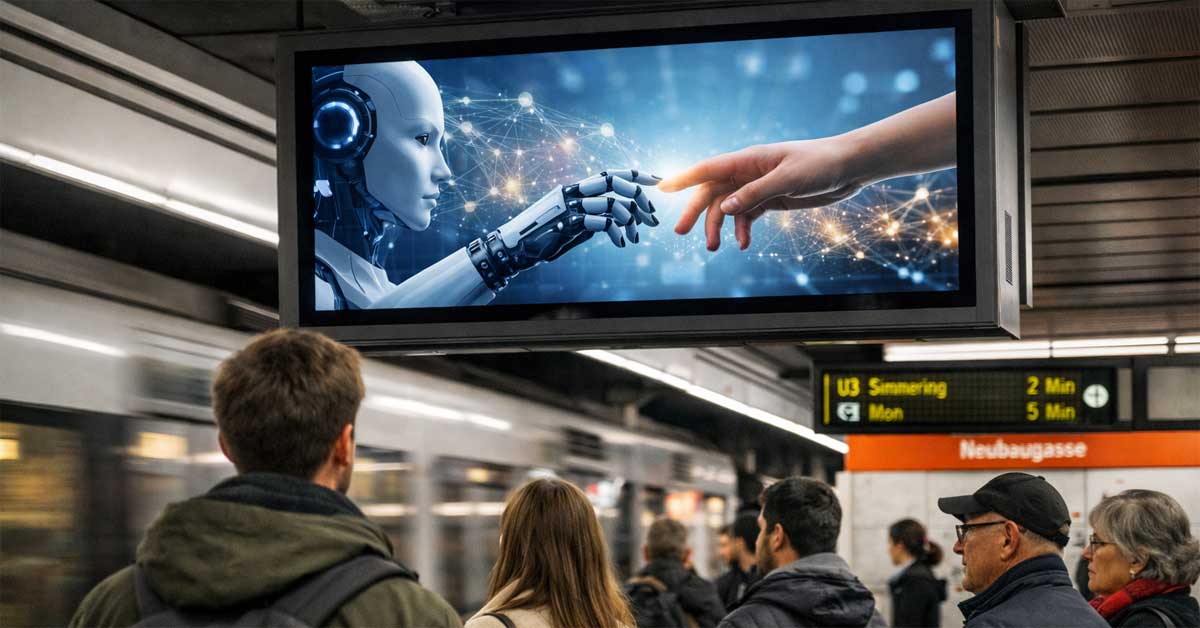 Every day thousands of commuters pass through underground stations, tram stops and bus platforms across Austria. Between news headlines and transport updates, digital screens display short pieces of visual content. In summer 2026, some of these screens will once again show contemporary art. The initiative "20 Seconds for Art" invites artists to create silent films that last exactly twenty seconds. The open call, organised by Infoscreen together with KÖR – Kunst im öffentlichen Raum Wien, asks participants to respond to a specific theme with a concise visual idea. The project was initiated in 2013 and takes place every two years. The 2026 edition marks the seventh competition. Art in everyday transit spacesInfoscreen is an Austrian digital out-of-home media company specialising in information and advertising systems in public transport. The company operates thousands of screens in underground stations, trams, buses and at stops across Austria. The network reaches commuters in cities including Vienna, Graz, Linz, Innsbruck, Klagenfurt, Eisenstadt and Salzburg.These screens usually provide news, weather information and advertisements. Through the collaboration with KÖR Wien, however, they also become a platform for artistic content. Around 4,800 screens are part of the network that will present the selected artworks during the summer of 2026. KÖR Wien — short for Kunst im öffentlichen Raum Wien (Art in Public Space Vienna) — is a programme dedicated to bringing contemporary art into public space. The organisation commissions and supports projects that encourage reflection on social, political and cultural issues. By placing artworks in everyday environments rather than museums, the initiative aims to reach audiences who might not actively seek out contemporary art. Changing themes reflecting societyEach edition of "20 Seconds for Art" focuses on a topic that reflects current debates in society. Previous themes have addressed issues such as Climate. Utopia & Reality in 2022 or "Community 3.0 – Public Space in the Digital Age" in 2024.The 2026 competition turns to the relationship between Humans and Intelligent Machines. Artificial intelligence has rapidly become a key technology shaping daily life — from data analysis and industrial production to communication and creative work. At the same time, it raises ethical and social questions about responsibility, autonomy and control. Artists participating in the competition are asked to interpret these questions visually in a silent film lasting twenty seconds. Artificial intelligence as a growing theme in artThe interest in artificial intelligence within contemporary art did not appear overnight. Artists have explored the relationship between humans and machines for decades. One early example can be found in cinema: in 1927, the film Metropolis by Fritz Lang introduced the iconic figure of a human-like machine.In recent years, however, the topic has gained new urgency as AI technologies entered everyday life. Contemporary artists increasingly experiment with algorithms, robotics and machine learning systems. Projects around the world illustrate this trend. Media artist Refik Anadol, for example, has created large-scale data installations that transform environmental information into immersive visual landscapes. In another direction, artist Sougwen Chung developed performances in which robotic drawing systems respond to the artist's movements and brainwave signals. Other projects explore the hidden labour behind AI training data or question how machines influence perception and decision-making. Such works demonstrate how artistic approaches to artificial intelligence range from fascination and collaboration to critical reflection. Twenty seconds to inform, surprise or amuseWithin the framework of "20 Seconds for Art," artists have only a short time to convey their ideas. Yet the format also encourages creativity. A film might show a humorous encounter between a human and a robot, visualise streams of data shaping a city landscape, or portray everyday situations in which algorithms influence decisions.Because the works are shown in busy transit spaces, the films must communicate quickly and visually. They can inform, provoke thought, or simply provide a moment of unexpected entertainment for people waiting for the next train. Even a brief smile during a commute can be part of the project's intention. The competition is open to artists, students and creative professionals aged 18 or older from Austria and abroad. Participants must submit a silent 20-second video in a digital format. Five winners will be selected by a jury. The selected works will be screened nationwide from 6 July to 30 August 2026 on approximately 4,800 Infoscreen displays in underground stations, trams, buses and at public transport stops in cities including Vienna, Graz, Linz, Salzburg, Innsbruck and others. Submissions for the 2026 competition are open until 15 April 2026. Detailed information on participation, technical requirements, submission guidelines and prize money is available on the official project website of KÖR Wien. Image: Passengers wait in a Vienna underground station while a digital screen above the platform shows a short film about the relationship between humans and intelligent machines. Photo: © Fashion.at / Generated with ChatGPT (OpenAI) |