
|
9 August 2026 Green, Pink, Lilac: How Altaussee Wears Its Landscape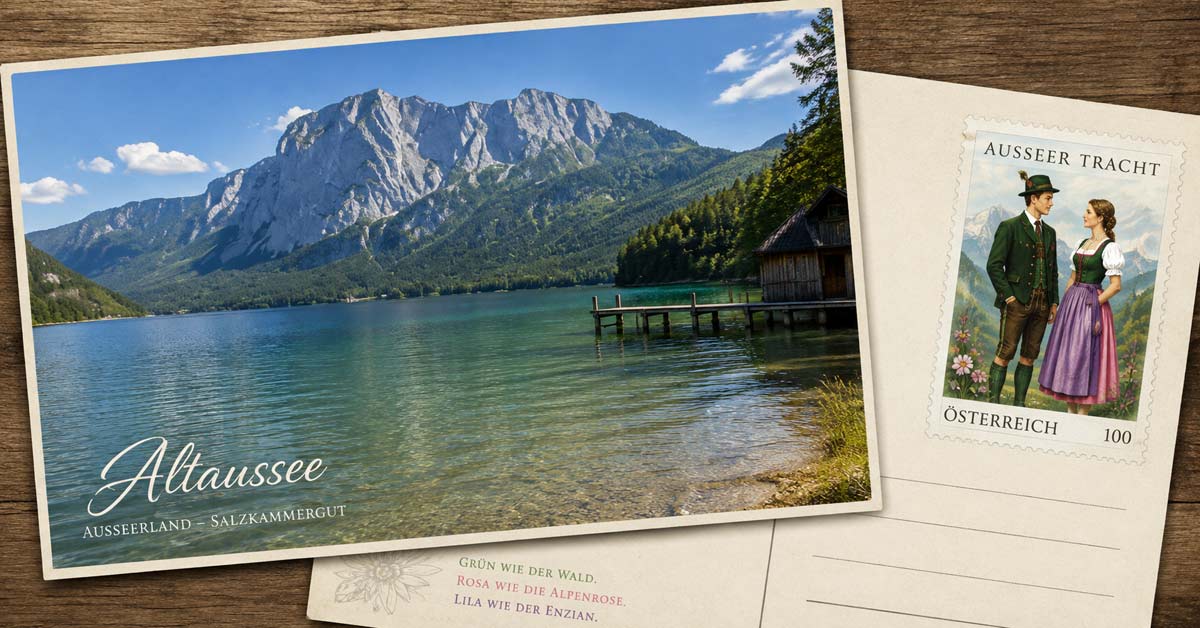
Quick Read
• Altaussee is less a destination for spectacle than a place for slowing down: the lake, mountains and old summer houses set the pace.
A lake framed by two very different mountainsAltaussee does not reveal itself all at once. There is no dramatic arrival sequence in which one attraction follows another. Instead, the place gradually becomes legible while walking, sitting by the lake or looking through the trees towards the mountains. The first impression is dominated by the Trisselwand, a massive rock face rising to the east of the lake. It is worth making the geographical distinction: the Trisselwand is not part of the Loser. The two are separate mountains belonging to the Totes Gebirge, and together they form much of the characteristic Altaussee panorama. The lake itself lies at about 712 metres above sea level and covers about 214 hectares. Its maximum depth is around 52.8 metres. A roughly 7.5-kilometre circular path follows the shore, with only modest elevation changes. It is therefore less an athletic challenge than a slow visual tour of the landscape.Early in the morning, swimmers can already be seen heading quietly towards the middle of the lake before breakfast. Later, the path becomes a sequence of small beaches, benches, wooden buildings and changing views of the mountains. One particularly atmospheric destination is the Seewiese, reached on foot along the lake path or by traditional boat. The historic Jagdhaus Seewiese, dating from the 19th century, also became recognisable internationally when scenes for the James Bond film Spectre were shot in the area. Today, the Seewiese is also associated with the Tauroa-run lakeside restaurant. Its location makes lunch or an early dinner part of the excursion rather than simply a break between sights. A village shaped by summer and saltAltaussee's apparent timelessness is not accidental. Its architectural character is the result of several layers of history. The Ausseer Haus developed from traditional buildings associated with farming and the salt-mining economy, later absorbing elements introduced by the summer visitors who began arriving in the 19th century. Today's regional architecture is the result of this long interaction between the buildings of the Salinen era and the villa architecture of the summer resort. That mixture is particularly visible in the wooden villas. Verandas, balconies, decorative timberwork and broad roof overhangs give some buildings a distinctly romantic appearance. The architectural history is more complex than simply calling them "traditional Alpine houses": the summer visitors brought new aesthetic ideas, while local building traditions provided the material and construction language. The result is an environment in which new and old buildings are expected to coexist without destroying the visual identity of the settlement. For visitors, this creates an unusual sense of continuity. The houses do not look like scenery added for tourists; they are part of the way the village has evolved.This is also where Altaussee's reputation as a summer retreat becomes understandable. As early as 1847, the area was attracting artists and affluent summer visitors. Writers including Arthur Schnitzler and Hugo von Hofmannsthal later became associated with the region. The Seevilla, for example, began life not as a hotel but as a private summer residence. Professor Laszlo Wágner had Villa Wágner built on the lake in 1880; Johannes Brahms later visited and music was performed in its pavilion. Green, pink and lilac: the landscape becomes clothingPerhaps nowhere is Altaussee's relationship with its surroundings more visible than in its traditional dress.The classic Ausseer Dirndl combines a green bodice, a pink skirt and a lilac apron. These colours are not simply a fashionable combination frozen in time. Regional tradition interprets them through the landscape: green refers to forest and meadows, pink to the alpine rose, and lilac to the gentian. There is an interesting historical qualification, however. The now-iconic three-colour combination is comparatively young. The characteristic form of the Ausseer Dirndl emerged around 120 years ago, while the pink skirt had already been described in the 19th century. Earlier examples show considerably more variation in colour and pattern. Men traditionally wear leather trousers with green stockings and a Spenzer, complemented by the characteristic Ausseer hat. During a stay in Altaussee, traditional dress can therefore seem less like a costume for visitors and more like an everyday part of local visual culture. Particularly during summer, the elegant interpretation of Tracht sits naturally alongside more relaxed contemporary clothing. There is no need for a visitor to imitate it. A light summer outfit with a little elegance fits the atmosphere just as well. But if a dinner, festival or local celebration is on the itinerary, packing something suitable for the occasion makes sense. The quiet luxury of not being noticedAltaussee has another characteristic that is harder to photograph: discretion.The village does not operate like a conventional resort town built around constant entertainment. There is little sense of a promenade designed for spectacle. Instead, cafés, hotels, villas and lakeside meeting places function as part of a community that has long combined local life with summer visitors. The Strandcafé is one such place, where locals and long-term summer residents meet alongside visitors. The Seevilla represents another layer of this culture, with its long history as a meeting place for artists and intellectuals and, since the 1950s, as a hotel. During the filming of Spectre in 2015, the hotel also hosted Daniel Craig and the film crew. At the other end of the spectrum is Mayrlife, whose deliberately quiet luxury reflects a very different tradition of retreat. The point is not visibility, but privacy. That may be the most convincing way to understand Altaussee: a place where retreat itself has become part of the culture. There is also a darker history beneath the tranquil surface. Salt mining in Altaussee has been documented since 1147, and during the Nazi period the mine became a repository for looted European art. From 1943 to 1945, thousands of artworks and cultural objects were hidden underground. The story later became part of the Monuments Men narrative. The 2024 European Capital of Culture programme revisited this history with Simon Schwartz's graphic-novel exhibition Hidden in the Rock: The Mountain, the Salt and the Art, connecting the history of the salt mine with the fate and recovery of the artworks. It is a useful reminder that Altaussee is more than its postcard. The lake may look timeless, but the village has repeatedly changed with the economic, cultural and political history of the region. And perhaps that is why the green, pink and lilac of the Ausseer Tracht make such a fitting final impression. They are not only colours of clothing. They turn the surrounding landscape into a visual code — forest, alpine flowers, mountains and summer life, condensed into something that can be worn. |