
|
23 August 2026 From Vienna to Danubiana: A Museum Journey by River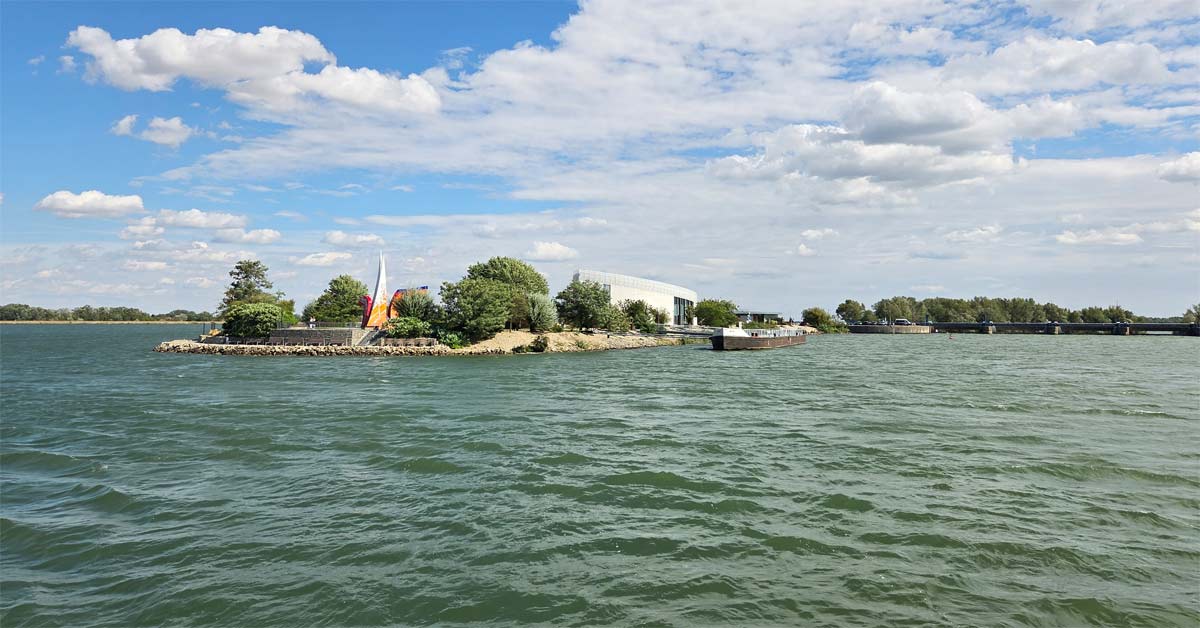
Quick Read
On 22 August 2026, Fashion.at joined a privately organised group trip to the Danubiana Meulensteen Art Museum near Bratislava. The visit was not planned as a journalistic assignment. But the journey, the museum's architecture and collection, and particularly the presentation of contemporary Chinese art proved sufficiently interesting to record the experience afterwards.
• A private trip from Vienna to the Danubiana Meulensteen Art Museum turned into an unexpected art report. From Vienna to the DanubeThe meeting point was the Hübner Kursalon in Vienna's Stadtpark. From there, a group of around 30 people—large enough to resemble a school class—continued to Bratislava and boarded a boat at the city's port. The approximately one-hour journey downstream changed the perspective. The Danube was no longer a background to the destination but became part of the visit itself: broad stretches of water, industrial and natural river landscapes, and finally the approach to the museum island at Čunovo.The Danubiana opened on 9 September 2000. It was founded by Dutch collector Gerard H. Meulensteen and Slovak gallerist Dr. Vincent Polakovič. Its location on the Danube peninsula, close to the borders of Slovakia, Austria and Hungary, is central to its architectural and exhibition concept. Ink, poetry and the movement of waterThe main new presentation on the visit was Fan Xueyi – The Magic of Ink, on view from 18 August to 25 October 2026 and curated by Wolfram Anders. The exhibition is held in cooperation with the Viennese Lukas Feichtner Gallery.Fan Xueyi, born in Heilongjiang in 1969, combines painting with a long-standing interest in poetry. Her work draws on the tradition of Chinese ink painting, in which water, ink, brush and paper create not only images but varying states of atmosphere. The tradition is closely connected with poetry and is often described as literati painting or scholar painting—a form in which painting and literary expression historically belong together. In Danubiana, this idea gains an unusually direct architectural counterpart. The works are shown in a space where the movement and changing light of the Danube remain perceptible beyond the architecture. Fan Xueyi's fluid ink landscapes therefore seem less like isolated images than quiet observations of change: something appears, dissolves and reappears, much as the river itself is constantly moving. Fan Xueyi's biography also connects the visual and literary sides of her work. She has written poetry since childhood, founded XYZ Gallery in Beijing's 798 Art District in 2006 and began painting in 2008. Her recent works include Further Than North and Album of Evening Fragrance. Eight Chinese artists, eight different approachesThe visit also included Renewal of Tradition 20/25, presenting selected works by eight Chinese artists. The exhibition runs until 30 August 2026 and was also curated by Wolfram Anders.Among the works, Gao Xiaowu's sculptures stand out for their combination of humour, social observation and physical presence. Falling Asleep – Beauty, from 2007, belongs to a series of eight sculptures. In conversation with Fashion.at, Gao explained the telephone receiver incorporated into the sleeping figure as a connection to wakefulness: even in sleep, a line to the outside world remains open. Another striking artwork comes from feminist artist Chen Qingqing. Her Blue Flower Dress from 2003 uses hemp fibres and dried flowers. Below, two installations titled Pigeon City from 2023 create a very different atmosphere. The contrast is almost theatrical: the delicate, wing-like dress, which brings to mind traditional Chinese attire, evokes a sense of lightness and transformation. Meanwhile, the doll-like figures in Pigeon City seem to be trapped in a bird cage with a mechanical system that looks like it is about to swallow them up. This juxtaposition demonstrates that tradition is not a fixed visual language, but rather something that can be questioned and reinterpreted. The museum describes the exhibition as a presentation of works ranging from traditional ink and oil painting to sculpture and installation, showing how Chinese artistic traditions continue to inform contemporary practice without simply being imitated or rejected. An architecture that becomes part of the visitAfter the boat journey, the museum itself becomes part of the story. Its architecture, sculpture park and position directly above the Danube create a setting in which art and landscape constantly overlap. The permanent collection combines works from the Meulensteen Collection with the museum's own holdings, including international and Slovak art.For Fashion.at, the most memorable aspect was precisely this relationship between architecture, water and art. From the river, the museum initially looks almost unreal—a long, bright structure set against sky, trees and water. Inside, the effect continues. Rooms open towards the landscape and make the changing river a kind of moving visual element. The private excursion therefore produced something that had not been planned at its beginning: a small journey report about how a museum can be reached, experienced and remembered not simply as a destination, but as a sequence of changing perspectives—from Vienna, to Bratislava, to the river, and finally to an island where contemporary art meets the Danube. Image: The Danubiana Meulensteen Art Museum on the Danube peninsula near Bratislava, photographed from the boat shortly before docking on 22 August 2026. © Fashion.at |