
|
31 August 2026 How Can Children Handle Unexpected Traffic Situations on the Way to School?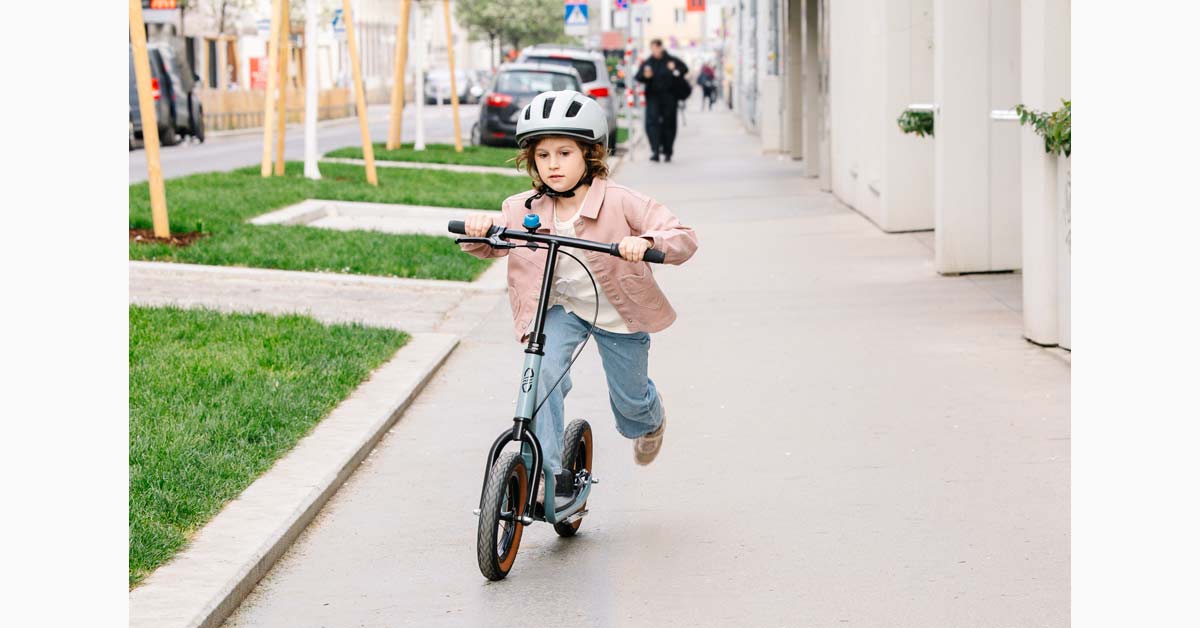
Quick Read
• A new joint safety project by sicher unterwegs and AUVA focuses on children using scooters on the school route. A digital school-route classroomThe newly published focus on Safe with the Scooter on the School Route is part of the interactive platform mein-sicherer-schulweg.at. The platform is a cooperation between sicher unterwegs – Verkehrspsychologische Untersuchungen and the Allgemeine Unfallversicherungsanstalt (AUVA).Vienna-based sicher unterwegs works in traffic psychology, mobility education, prevention, research and driver-related assessments. Its partner network includes institutions such as AUVA, BOKU's Institute of Transport Studies, TU Graz's Vehicle Safety Institute, the University of Bonn's Institute of Psychology and SWARCO, as well as driving schools and Red Cross organisations. Its educational work starts early. For younger children there is a traffic laboratory for four- to six-year-olds, while parents and educators can attend workshops for kindergarten and primary-school children. There is also a cycling workshop for parents and educators. The AUVA, Austria's largest statutory accident insurer, covers more than 4.7 million people and combines four main areas: prevention, accident treatment, rehabilitation and financial compensation. Prevention is not an add-on to this work: the AUVA describes accident prevention as one of its central tasks. Why the scooter has become a safety issueThe new material responds to a measurable change. After the pandemic-related decline in 2020, recognised scooter accidents involving schoolchildren rose steadily and reached 97 cases in 2024. The increase was particularly marked on school journeys, where the number of so-called route accidents rose from 24 in 2020 to 74 in 2024. The practical advice is deliberately simple: well-fitting shoes, a technically sound scooter and anticipatory behaviour matter. AUVA also points to equipment such as large air-filled wheels, an easily reachable brake, a non-slip deck and a bell.But equipment is only one part of the equation. The platform's existing "My Skills" section explains why practising before a child travels independently can be so important. Children are not simply smaller adults: the abilities required for safe traffic participation develop throughout childhood and, in some areas, into young adulthood. Three senses, three different challengesVisually, a primary-school child may see a car but still struggle to judge how quickly it is approaching or how much distance is actually available. Research on road-crossing decisions shows that children under 13 have longer hazard-perception latencies and respond less consistently to some traffic hazards than adults.Auditory perception also develops with age. A child may hear an approaching vehicle but have difficulty identifying its direction when several sounds compete – for example, traffic, other children and conversation. The platform therefore treats hearing as a specific traffic skill rather than assuming that "hearing a car" automatically means understanding the danger. Psychomotor skills are equally relevant on a scooter. Balancing, steering, braking and looking around at the same time require coordination. A child who turns their head to check traffic may momentarily lose control of the scooter or drift towards the edge of the pavement. The platform explicitly identifies balance, coordination, attention and motor security as important parts of safe scooter use. There is therefore no useful single percentage for saying that "children react X percent more slowly than adults": reaction time varies substantially with age, task and situation. Research does, however, consistently show developmental differences in hazard perception and response. Eight years old – but not automatically traffic-wiseEight is roughly the middle of Austria's four-year primary-school period, but it should not be confused with a point at which a child suddenly acquires adult traffic skills. In Austria, children may use a conventional, muscle-powered Tretroller independently from their eighth birthday. The legal permission does not mean that every eight-year-old is equally ready for every traffic situation. There is also an important rule that can easily be misunderstood: a conventional Tretroller does not belong on the road or on a cycle path. It may be used on pavements and footpaths, as well as in residential and play streets, at walking pace and only if pedestrians are neither endangered nor obstructed. That is where traffic responsibility begins to extend beyond the child. "Being allowed to ride" does not mean having priority over everyone else. On a pavement, the pedestrian remains the person to accommodate. A child approaching a crowded section therefore has to slow down, leave enough space and, where necessary, get off and push. At crossings or places with poor visibility, sicher unterwegs recommends getting off the scooter and walking it across – a simple action that creates more time to see what is happening.The new series builds on precisely this idea. Every week, a new digital learning tip is planned, accompanied by short videos in which children explain safe scooter handling to other children in an age-appropriate way. The interesting question for parents may therefore not be "Does my child know the rules?" but: Would your child know what to do when the situation suddenly changes? Image: A primary-school-aged girl wearing a helmet rides a scooter along a city pavement, illustrating safe and independent mobility on the school route. © Mag. Alek Kawka |