
|
27 September 2026 Sonic Territories 2026: Water, Sound and Urban Space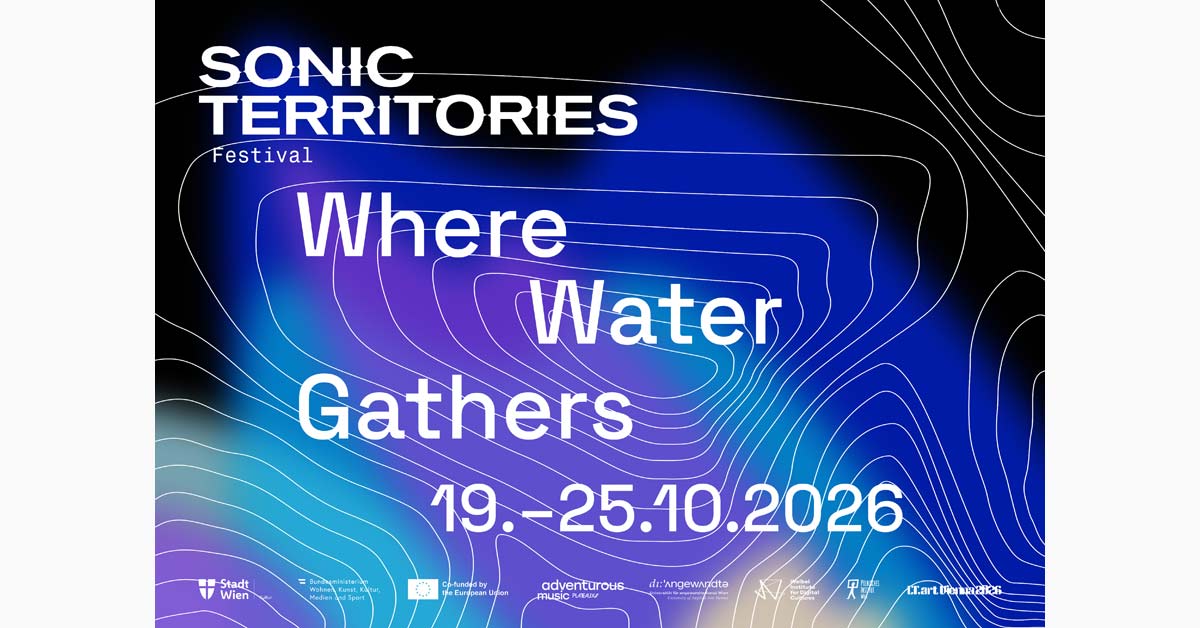
Quick Read
• 19–25 October 2026: Sonic Territories returns to Vienna with Where Water Gathers as its guiding theme. From sound art festival to urban listening practiceSonic Territories began in Vienna in 2018 as a festival for Sound Art and Exploratory Music. From the beginning, its interest was broader than music in a conventional concert setting: sound was approached as a spatial experience, intersecting with improvisation, composition, visual art, performance and media art.The festival has since developed into a recurring platform for experimental and interdisciplinary work. Its history also shows that the themes change with social and artistic circumstances. In 2020, during the pandemic, the programme used the striking title This ain't Disneyland, you can't turn that river off. Now What?; 2021 focused on new forms of togetherness with What's between your head and mine?, while 2022 used Soundness, 2023 From Liminal Attraction To Intra-Action. After further editions, 2024 was devoted to Breaking Free and 2025 to Life Is Good in the New Real (source: archive of Sonic Territories). Where water gathers in ViennaFor 2026, the title Where Water Gathers provides a common thread rather than simply a subject for individual works. Water becomes a way of thinking about movement, transformation, infrastructure and connection. The programme therefore moves between places with very different acoustic qualities.The main festival week runs from 19 to 25 October, with the Otto Wagner Areal serving as an opening and closing location, while several churches provide settings for site-specific works. Seestadt Studios becomes a space for collective listening and artistic research. The 2026 programme, however, extends beyond this October week: earlier projects have already brought Sonic Territories to the Donaukanal and Wasserturm Favoriten, while the wider programme also includes Kritzendorf and other sites connected to water. Together, these locations underline the festival's interest in Vienna as an environment for sound, rather than simply a backdrop for performances. This makes Sonic Territories resemble an acoustic city walk more than a conventional festival route: audiences move between places and encounter how architecture, distance, reverberation and the surrounding city alter the experience of sound. Vienna voices meet international positionsA substantial part of the programme is rooted in Vienna's experimental music and sound-art scene. One example is Robert Pockfuß, whose work on 23 October is presented together with Polish composer Aleksandra Słyż at the Erlöserkirche am Schüttel. Pockfuß contributes a new work for organ and electric guitar, placing two very different sound sources in the resonant environment of the church.Słyż brings a distinctly international perspective. The Polish composer works with acoustic and synthetic sounds, creating complex microtonal drone structures. Her Sonic Territories appearance is also her Vienna premiere and is presented in cooperation with the Polish Institute in Vienna. In early 2026, Słyż received Poland's Paszport Polityki in the classical-music category. Another international presence is Brandon LaBelle, the US artist, writer and researcher whose work has long examined sound, listening, space and social relations. At Seestadt Studios on 24 October, his public listening session Sounding Cosmopoetic Rhythms: Time and Temporal Agency considers how social rhythms and concepts of time shape individual and collective life. Alongside performances, the festival therefore also treats listening as a form of research. The three-day Artistic Research Lab Listening Collectively: Acoustic Flows, directed by Kristina Pia Hofer, Yvo Kaufmann and Denise Helene Sumi, investigates collective, bodily and spatial listening. Hofer contributes theoretical input from contemporary sound studies, while the project brings together artistic and academic approaches. It is developed in cooperation with the University of Applied Arts Vienna, the Weibel Institute for Digital Cultures and Jugend am Werk. A Viennese festival with wider connectionsSonic Territories remains firmly based in Vienna, but its programme connects the city's experimental scene with international artists and European networks. Its partnerships with institutions such as the University of Applied Arts Vienna and the Weibel Institute also place sound art within a wider field of artistic research.The European dimension is particularly visible in Adventurous Music Plateaux (AMP), which is part of the 2026 programme. The platform connects artists working in jazz, improvisation and electronic music across several European countries and develops new forms of documentation using 360° video and Dolby Atmos. The AMP project itself is co-funded by the European Union. For Vienna, the significance of Sonic Territories lies less in scale than in the way it connects experimental artistic practice with the city itself. Churches, former industrial and architectural sites, new urban districts and research spaces become temporary listening environments. The result is a different way of encountering Vienna – not only through what can be seen, but through what a place sounds like. The complete 2026 programme, dates, locations and further information are available on the Sonic Territories website. Image: Flyer; Sonic Territories 2026 explores water, sound and urban space at different locations across Vienna. © Sonic Territories |