
|
30 June 2026 EU's New €3 Customs Duty Reshapes Low-Value Imports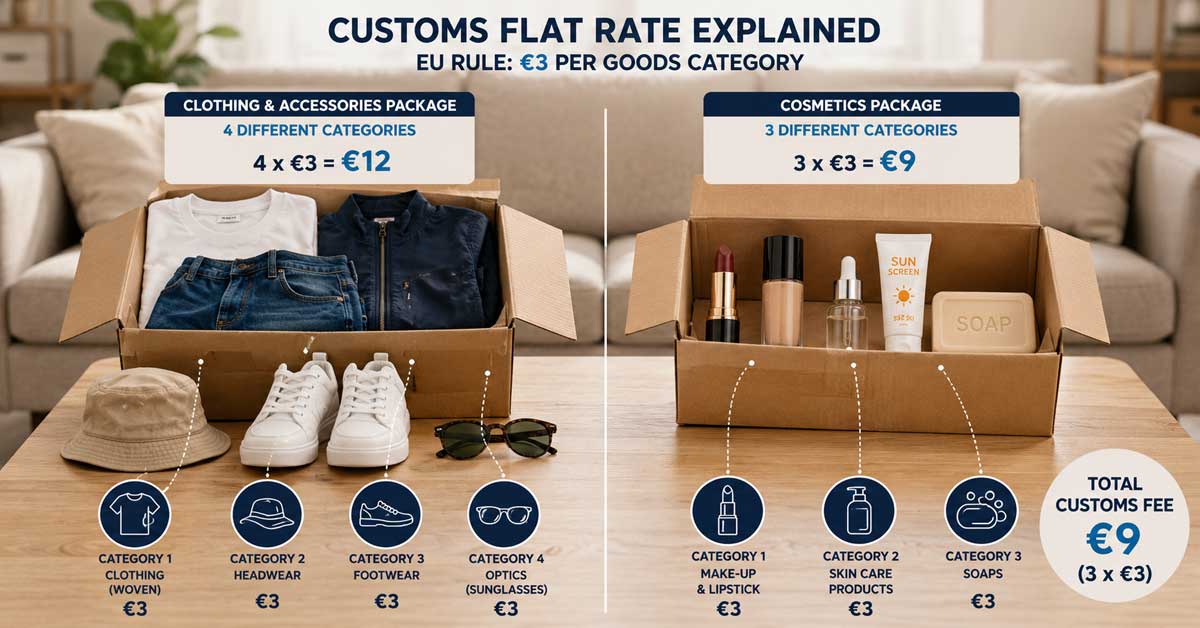
Quick Read
• From 1 July 2026, every EU country applies the same new customs rule for low-value imports from outside the EU. A new EU-wide rule for online shoppingFrom 1 July 2026, consumers across the European Union face a new customs framework for low-value online purchases from countries outside the EU. The previous customs duty exemption for consignments valued below €150 has been abolished. Instead, a temporary flat-rate customs duty of €3 now applies to eligible low-value imports arriving directly from third countries. The measure was adopted by the Council of the European Union as an interim solution before the planned reform of the EU Customs Code in 2028.The regulation applies uniformly in every EU Member State. It covers imports from all third countries, including countries that have association or free trade agreements with the EU, because the determining factor is that the parcel enters the EU customs territory from outside the Union. This includes countries such as China, the United States, the United Kingdom and Switzerland. How the customs duty is calculatedThe €3 customs duty is charged per customs product category rather than simply once per parcel. A shipment containing 7 T-shirts falls within a single customs category, meaning the duty is charged only once. However, a parcel containing a T-shirt (from a woven fabric), jeans and a jacket (clothing), shoes, a hat and sunglasses represents four different customs categories, resulting in four separate €3 customs duties.The same principle applies to cosmetics. A parcel containing foundation and lipstick (make-up), sunscreen and facial serum (skin care), together with soap, covers three customs categories and therefore attracts three separate customs duties. Import VAT continues to apply under the existing rules. Vienna retailers expect fairer competitionFor Vienna's retail sector, the new customs duty is primarily about restoring more equal competitive conditions. According to Margarete Gumprecht, Chairwoman of the Retail Division at the Vienna Chamber of Commerce, the previous exemption gave sellers outside the EU a structural advantage while European retailers had to comply with extensive product safety, consumer protection and environmental requirements. She argues that applying customs duties to low-value imports is a first step towards reducing this imbalance.The scale of the issue has grown rapidly. According to the European Commission, around 4.6 billion consignments valued below €150 entered the EU in 2024, with more than 90 percent originating in China. The enormous volume has presented increasing challenges for customs authorities and market surveillance. The retail sector also expects international online marketplaces to continue expanding European fulfilment centres. Platforms including Temu and Shein have already increased their use of logistics hubs within the EU. When products are imported into Europe in bulk and stored in EU warehouses before being sold to consumers, the new €3 customs duty on individual consumer parcels no longer applies because the goods have already entered the EU customs territory through commercial imports. At that stage, however, the products become subject to the normal customs procedures applicable to commercial imports, supporting the EU's objective of ensuring that imports contribute to customs revenues and are more effectively monitored. A European measure — but debate continues in AustriaWhile Vienna's retail representatives welcome the EU-wide customs duty, they distinguish it from Austria's planned national parcel levy, which is expected to take effect on 1 October 2026. Unlike the EU customs measure, the Austrian proposal would also affect domestic and intra-EU deliveries. The Vienna Chamber of Commerce argues that such a levy would place an additional burden on Austrian retailers rather than specifically targeting imports from outside the European Union.Fashion.at recently examined the debate surrounding the planned Austrian parcel levy in more detail: Austria's Planned Parcel Tax Divides Retail, Digital Economy and Sustainability Groups Image: Two parcels on a living room table show EU customs flat-rate rules. Left: clothing (T-shirt from a woven fabric, jeans, jacket, shoes, hat, sunglasses) across four categories (€12 total). Right: cosmetics (lipstick, makeup, serum, sunscreen, soap) across three categories (€9 total). © Fashion.at / AI-generated with ChatGPT. |